

Blue Laser Cracks a 150-Year-Old Physics Puzzle
For more than 100 years, physicists suspected that a strange magnetic signal was present in common metals like copper and gold, but it remained undetected—until now. Using just a blue laser and an innovative modification of a classic method, researchers have finally observed the elusive optical Hall effect.
This discovery uncovers hidden magnetic properties in materials previously considered magnetically inactive and opens up exciting possibilities in spin physics, quantum technologies, and electronic design—all without the need for wires or extreme conditions.
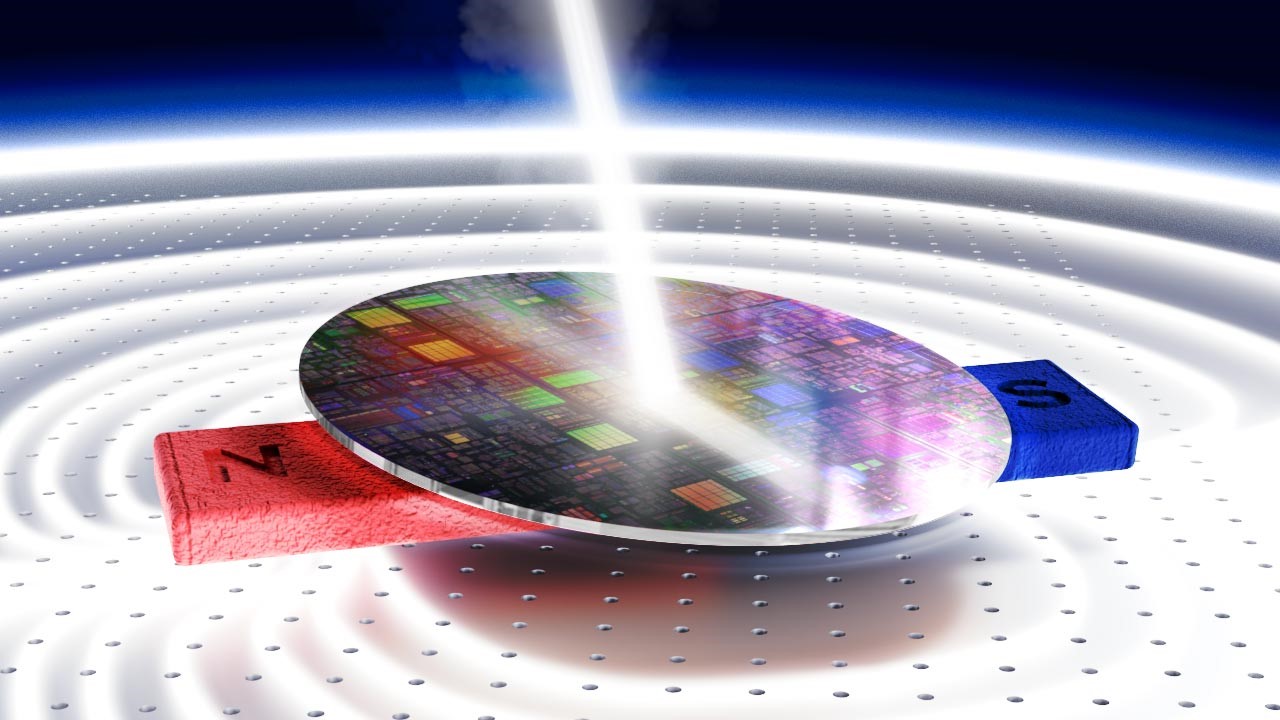
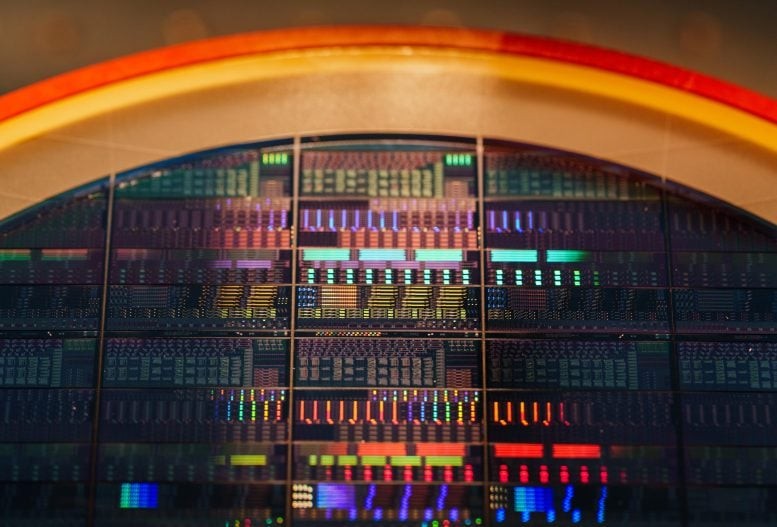
Figure 1. Optical Hall Effect in Silicon Wafer
Illuminating a Long-Hidden Magnetic Signal
A team of researchers has developed a groundbreaking method to detect extremely weak magnetic signals in common metals such as copper, gold, and aluminum—using only light and an enhanced optical technique. Published in Nature Communications, their findings could pave the way for significant progress in technologies from smartphones to quantum computing. Figure 1 shows Optical Hall Effect in Silicon Wafer.
The Enduring Mystery: Why Has the Optical Hall Effect Eluded Detection?
Scientists have long understood that electric currents bend in the presence of magnetic fields—a phenomenon known as the Hall effect, which is well studied in magnetic materials like iron. However, in non-magnetic metals such as copper and gold, this effect is much weaker and harder to detect.
A related but lesser-known phenomenon called the optical Hall effect was predicted to shed light on how electrons behave under the influence of both light and magnetic fields. Despite over a century of theoretical support, this effect has remained too subtle to observe with visible light, as no technique had been sensitive enough to confirm its existence—until now.
“For decades, it was like trying to catch a whisper in a noisy room,” said Prof. Amir Capua. “Everyone suspected the whisper existed, but no one had a microphone sensitive enough to pick it up.”
Decoding the Invisible: A Breakthrough Discovery
Led by Ph.D. candidate Nadav Am Shalom and Prof. Amir Capua from the Institute of Electrical Engineering and Applied Physics at Hebrew University, in collaboration with Prof. Binghai Yan from the Weizmann Institute of Science, Pennsylvania State University, and Prof. Igor Rozhansky from the University of Manchester, the study tackles the challenging task of detecting tiny magnetic effects in materials typically considered non-magnetic.
“Metals like copper and gold might seem magnetically ‘quiet’ since they don’t stick to your fridge like iron,” said Prof. Capua. “But in truth, under certain conditions, they do respond to magnetic fields—just in incredibly subtle ways.”
The main challenge has been detecting these minuscule effects, particularly using visible light where lasers are commonly accessible. Until now, the signal remained too weak to be observed.
Amplifying the Faint Magnetic Signals
To overcome this, the researchers enhanced a technique called the magneto-optical Kerr effect (MOKE), which uses a laser to detect how magnetism changes the way light reflects off a surface. Imagine shining a powerful flashlight to catch the faintest sparkle in the dark. By combining a 440-nanometer blue laser with strong modulation of the external magnetic field, they significantly increased the method’s sensitivity. This breakthrough allowed them to detect subtle magnetic "echoes" in non-magnetic metals such as copper, gold, aluminum, tantalum, and platinum—something once thought nearly impossible.
The Importance of Turning Noise into Signal
The Hall effect is a crucial technique in the semiconductor industry and atomic-scale material studies, helping scientists determine the number of electrons in a metal. Traditionally, measuring the Hall effect involves attaching tiny wires to the device, a process that is both delicate and time-consuming, especially for nanoscale components. The new method simplifies this by only requiring a laser to shine on the electrical device—no wires needed.
Further analysis revealed that what seemed like random “noise” in their measurements was actually a distinct pattern linked to a quantum property called spin-orbit coupling, which connects the motion of electrons with their spin—an important phenomenon in modern physics.
This relationship also influences how magnetic energy dissipates in materials, with significant implications for designing magnetic memory, spintronic devices, and quantum technologies.
“It’s like realizing that static on a radio isn’t just interference—it’s a secret message,” said Ph.D. candidate Am Shalom. “Now, we’re using light to ‘hear’ these hidden signals from electrons.”
Future Perspectives: Unlocking New Insights into Spin and Magnetism
This technique provides a non-invasive, highly sensitive method to study magnetism in metals without relying on large magnets or extreme cooling [1]. Its simplicity and accuracy could pave the way for faster processors, more energy-efficient devices, and ultra-precise sensors.
“This research transforms a nearly 150-year-old scientific challenge into a new opportunity,” said Prof. Capua.
“Interestingly, even Edwin Hall—the pioneering scientist who discovered the Hall effect—tried to detect this effect using light but was unsuccessful. In his 1881 paper, he concluded, ‘I think that, if the action of silver had been one tenth as strong as that of iron, the effect would have been detected. No such effect was observed.’ (E. Hall, 1881).”
“By tuning into the right frequency and knowing where to look, we’ve finally found a way to observe what was once considered invisible.”
References:
- https://scitechdaily.com/this-blue-laser-just-solved-a-150-year-physics-mystery/
Cite this article:
Janani R (2025), Blue Laser Cracks a 150-Year-Old Physics Puzzle, AnaTechMaz, pp.331
Recent Post
-
Blue Laser Cracks a 150-Year-Old Physics Puzzle
For more than 100 years, physicists suspected that a strange magnetic signal was present in...
-

Physicists Set New Record for Qubit Coherence, Pushing Quantum Limits
On July 8, 2025, researchers at Aalto University in Finland announced...
-

fortios: Ensuring Quantum-Safe Security in the Era of Advanced Computing
Traditional encryption has safeguarded data for years, but the emergence of...
-
Breakthrough in Measurement Tech: New System Approaches Physics' Theoretical Boundaries
Fast, precise, and field-ready—a quantum-level optical frequency...
-

New Quantum Technology May Finally Prove the Existence of the Multiverse
Imagine a gamma ray laser so precise that it can destroy cancer cells...
-

Harvard Engineers Pack a Quantum Computer into a Tiny Chip
In a breakthrough that could reshape the future of quantum technology, engineers at Harvard have developed...
-
Quantum Leap: Scientists Uncover Hidden Clue to Solving a 60-Year-Old Superconducting Puzzle
A team in Copenhagen has discovered an ingenious “backdoor” method...
-

U.S. Mathematicians Transform ‘Pure’ Math Once Deemed Impractical into a Quantum Computing Breakthrough
Researchers at the University...
-
Physicists Astonished by Groundbreaking Room-Temperature Quantum Discovery
In a groundbreaking leap for quantum science, researchers have shown ...
-

Physicists Develop a “Quantum Lie Detector” to Expose Fake Quantum Computers
Is it possible to verify whether a large quantum system genuinely follows...
-

Chinese Scientists Reveal Atom Array 10 Times Larger, Paving Way for Next-Generation Quantum Processors
Chinese scientists have made a...
-

Harnessing Sound Waves: A Breakthrough Route to Practical Quantum Computing
Caltech researchers have designed a new kind of hybrid quantum...
-

Quantum Guitar: Scientists Resolve 90-Year-Old Puzzle of the Damped Harmonic Oscillator
Imagine plucking a guitar string. It vibrates, the sound lingers, and ...
-

Scientists Create ‘World’s Smallest Cat Video’ to Push Quantum Computing Forward
A team of physicists in Shanghai has made what they call the...
Sandia Harnesses Chiplet Technology to Advance AI and Quantum Computing
Sandia has a long-standing track record in semiconductor research, driven by...