

Magnetic Field Innovation May Pave the Way for Low-Cost MRIs in Rural Hospitals
German Physicists Redesign Magnetic Fields, Opening Door to Affordable MRI and Advanced Technologies
German researchers have achieved a major breakthrough in magnetic field design, surpassing the long-dominant Halbach array with a more compact, cost-effective setup that generates stronger and more uniform magnetic fields.
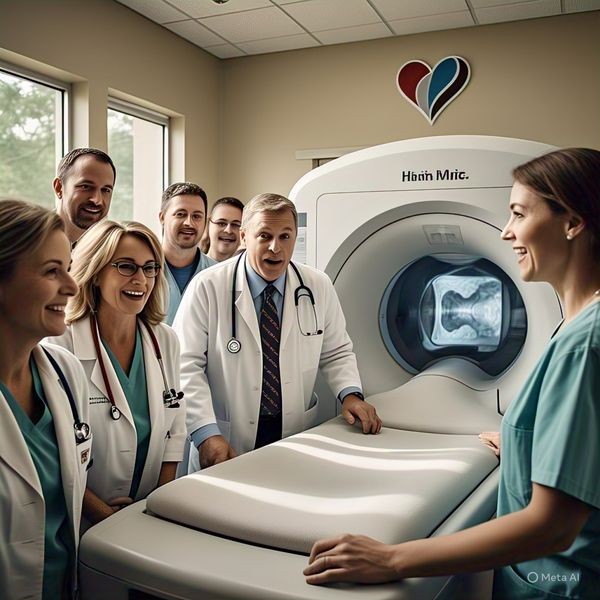
Figure 1. low-cost MRIs.
Led by Professor Ingo Rehberg of the University of Bayreuth and Dr. Peter Blümler of Johannes Gutenberg University Mainz, the team developed a novel arrangement of permanent magnets in optimized 3D orientations. This innovation produces consistently uniform magnetic fields—a longstanding goal in applied magnetism. Figure 1 shows low-cost MRIs.
Rethinking Magnetic Precision
The discovery could revolutionize technologies that rely on stable, high-quality magnetic fields, including low-cost MRI machines for underserved areas, particle accelerators, and maglev systems.
While the traditional Halbach array theoretically creates a uniform magnetic field, it requires an impractically infinite circular magnet arrangement. In real-world scenarios with finite-sized magnets, this leads to uneven field distributions.
Rehberg and Blümler’s design overcomes these limitations by maintaining field strength and uniformity even in compact formats. Their research explored two main geometries—a single ring and a stacked double ring—and introduced a “focused” configuration that extends uniformity beyond the plane of the magnets, ideal for devices interacting with nearby objects or tissues [1].
Verified Performance
To validate the concept, the team built physical prototypes using 16 neodymium-iron-boron (FeNdB) magnets mounted on 3D-printed structures. These powerful magnets are well-suited for small-scale experimental setups. Measured magnetic fields closely matched theoretical models, with the new design outperforming the classical Halbach array in both intensity and consistency.
Transforming MRI Accessibility
One of the most promising applications lies in medical imaging. Traditional MRI systems rely on superconducting magnets that are complex, expensive, and require cryogenic cooling—making them inaccessible in many parts of the world.
The new magnet configuration offers a low-cost, energy-efficient alternative based on permanent magnets, paving the way for MRI systems that are more compact, portable, and suitable for rural clinics, mobile health units, and low-resource settings.
Broader Applications
Beyond healthcare, this innovation could significantly enhance the performance of technologies that require uniform magnetic fields, such as precision sensors, maglev transportation, and scientific research equipment.
By overcoming a key theoretical and practical challenge in magnetic design, this research marks a meaningful step toward democratizing powerful magnetic technologies across industries and regions.
Reference:
- https://interestingengineering.com/science/compact-magnet-design-outperforms-halbach
Cite this article:
Keerthana S (2025), Magnetic Field Innovation May Pave the Way for Low-Cost Mris in Rural Hospitals, AnaTechMaz, pp.338
Recent Post
-

U.S. Startup Unveils World’s First Supersonic Artillery Shell, Capable of Reaching Mach 3.5 Speeds
A major breakthrough in artillery technology was announced at the...
-

A Digital Twin Reveals Overlooked Battery Blind Spot in Energy Storage Systems
A recent case study has introduced digital twins as a promising tool...
-

Point-of-Care to Precision: Carbon Nanodots Driving the Next MedTech Revolution
In an era where precision, personalization, and portability...
-

Inside the Chat: Can Governments Hack WhatsApp? Expert Explains the Possibilities
Earlier today, Iranian officials called on citizens to delete WhatsApp from..
-

World’s First Solar-Powered Drone with Boeing 747-Sized Wingspan Can Stay Airborne for a Month
In an effort to revolutionize long-range maritime surveillance and strategic....
-

Chinese Researchers Test Neural Implant Enabling Amputee to Control Cursor Using Only Their Mind
China has become the second....
-
China Begins Producing Yttrium-90 For Cancer Treatment Using Commercial Nuclear Reactor
China has taken a major step forward in cancer therapy by...
-
Magnetic Field Innovation May Pave the Way for Low-Cost MRIs in Rural Hospitals
German researchers have achieved a major breakthrough in magnetic field...
-
World’s First Biodegradable Cooling Film Cuts Energy Consumption By 20%—No Electricity Required
A team of researchers from....
-

Airbus Upgrades A400M Into a Combat-Ready Powerhouse with Drones and Electronic Warfare Tools
Airbus is evolving the A400M from....
-

World’s First Hybrid Solar Cargo Ship Set to Sail, Equipped With 192 Panels Generating 37,500 Kwh of Power Annually
Dutch solar innovator Wattlab and...
-

U.S. Engineer Develops One-Step Process to Produce Plastic Alternatives Using Bacteria
Amid growing concerns over plastic pollution, a U.S. engineer....
-

New Diagnostic Technology Harnesses Coffee-Ring Effect to Detect Deadly Diseases in Just 12 Minutes
Researchers at the University of...
-
Boosting RAM: New Magnetic Memory Cuts Write Power by 35% While Setting Speed Record
In a major leap toward ultra-efficient, high-speed memory...
-

Robotic Metabolism Could Enable Machines to Self-Repair Without Needing Human Assistance
We’ve witnessed robots perform some truly remarkable feats....