

Nuclear Breakthrough: UK Converts First Can of Radioactive Plutonium into Stable Waste
The UK holds around 140 tonnes of plutonium, accumulated since the 1950s for both strategic and commercial purposes. The UK’s Nuclear Decommissioning Authority (NDA) has reached a major milestone by successfully converting its first can of plutonium residue into a stable waste form. This achievement marks the start of a decades-long effort to safely manage and dispose of the UK’s civilian plutonium stockpile, most of which is stored at the Sellafield nuclear site in Cumbria.
Plutonium is produced when uranium fuel inside nuclear reactors is irradiated. It exists in multiple isotopic forms and can be separated from spent nuclear fuel. For decades, the UK chose to reprocess spent fuel—not only from its own reactors but also from international partners—leading to the accumulation of significant plutonium reserves.
Because plutonium can also be used in nuclear weapons, the material has long attracted public scrutiny. Although it is securely stored in specially designed containers at dedicated facilities in Cumbria, there has been growing pressure to convert the material into a stable form suitable for long-term disposal.
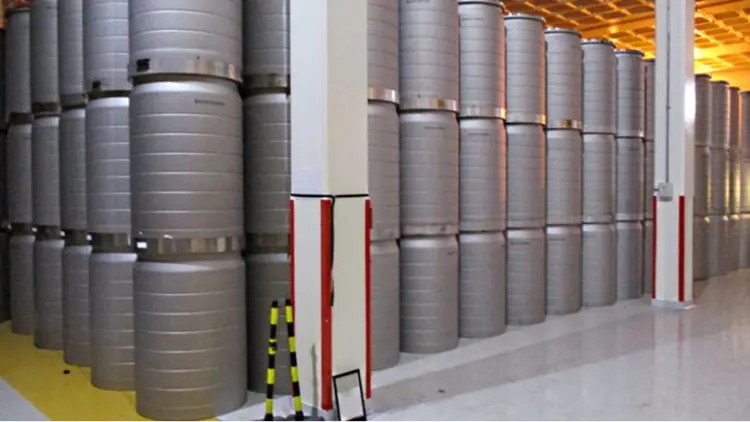
Figure 1. Radioactive Plutonium.
The NDA’s role
The NDA is responsible for cleaning up the UK’s early nuclear sites in a safe, secure, and cost-effective manner. Many of these facilities were originally used during the Cold War to produce nuclear materials before later transitioning to civilian power generation. While these sites have now been shut down, extensive cleanup is required before they can be repurposed or released. Figure 1 shows Radioactive Plutonium.
A large proportion of the UK’s nuclear waste inventory is located at Sellafield. In 2024, the UK government approved £154 million ($206 million) in funding to develop plutonium disposal capabilities. Over five years, this investment will support the creation of specialized laboratories to test and refine technologies for safe plutonium immobilization.
This work is critical because much of the plutonium at Sellafield exists in a hazardous powder form and must be stabilized before disposal. The NDA is currently evaluating two immobilization approaches. One option, Disposal MOX (DMOX), converts plutonium into ceramic pellets designed for permanent disposal [1]. The second, Hot Isostatic Pressing (HIP), uses high temperatures and pressures to form a durable, rock-like ceramic material.Once immobilized, the waste will ultimately be placed in the UK’s Geological Disposal Facility (GDF), which has been under development at Sellafield since the 1980s.
Just The Beginning
Processing the first can of plutonium residue represents only the initial step in a cleanup effort expected to span more than a century. The Sellafield site alone contains around 400 cans of similar plutonium residue.
“This UK-first milestone demonstrates the unrivalled expertise of the NDA group, with special recognition for the Sellafield team whose innovation and specialist skills have made this achievement possible,” said David Peattie, NDA Group CEO, in a press release.
“While the full immobilization programme will take many decades, converting this first can of residue into a disposable form marks significant progress and was achieved within just 12 months of the policy announcement,” he added. Peattie emphasized that addressing the UK’s plutonium legacy will remain a long-term priority. “With the government’s substantial investment, we are proud to be leading the work to make the UK safer for generations to come.”
References:
- https://interestingengineering.com/energy/uk-nuclear-body-plutonium-safe-disposal
Cite this article:
Keerthana S (2025), Nuclear Breakthrough: UK Converts First Can of Radioactive Plutonium into Stable Waste, AnaTechMaz, pp.314
Recent Post
-
Gigapascal Plasma Reached as FuZE3 Marks Major Fusion Milestone
Using its newest Fusion Z-pinch Experiment (FuZE-3), Zap Energy...
-
Compact Laser Technology Could Redefine Medical and Manufacturing Applications
Researchers have created a groundbreaking and adaptable ...
-

Chaotic Bubbles Validate a 100-Year-Old Physics Prediction
Researchers have discovered experimental proof that a fundamental theory of turbulence applies...
-
Ultra-Light, Ultra-Strong Material Survives 932°F — A Game-Changer for Aerospace
Researchers have created an exceptionally lightweight yet ....
-
Lithium Has Been Extracted from Discarded Batteries Using a Cost-Effective, Electrochemically Driven Recovery Process
Researchers in the United States...
-

Chinese Solid-State EV Battery Giant Wins Eight Patents for Future Battery Tech
Tinci’s newest patents signal rapid progress in solid-state....
-
1950s Material Is Making a Major Comeback—and Could Redefine Modern Computing
Researchers are exploring hole mobility in compressively strained ....
-
INL Marks a Milestone as First TRISO Fuel Shipment Arrives for Upcoming Demonstration Reactor
The United States has taken a significant step toward deploying its...
-
A Breakthrough Material for Buildings Can Store Carbon Instead of Emitting it
A new carbon-negative building material developed at...
-
Explained: Small Modular Reactors and Their Role in Supporting Rising Global Power Demand
Small modular reactors (SMRs) are quickly moving from ...
-
Scientists Trace Atoms in Real Time as They Melt, Uncovering A Never-Before-Seen Transitional Phase
Scientists have directly ....
-
MIT Study Sheds New Light on Proton Dynamics Inside Metal Oxides
As renewable energy technologies such as fuel cells and electrolyzers ...
-
Game-Changing Flexible Battery Material Promises 45% Boost in Drone and EV Range
A new battery manufacturing approach that avoids the use of explosive...
-
Nuclear Breakthrough: UK Converts First Can of Radioactive Plutonium into Stable Waste
The UK holds around 140 tonnes of plutonium, accumulated since...
-
Exciton Tomography Maps Electron-Hole Correlations in 2D Materials
Excitons—quasiparticles formed by bound electron-hole pairs—are key to understanding a material’s optical....