

Scientists Trace Atoms in Real Time as They Melt, Uncovering A Never-Before-Seen Transitional Phase
Scientists have directly visualized a long-mysterious intermediate phase during melting, upending decades-old theory. A research team from the University of Vienna captured the most detailed view ever of how ultra-thin materials melt—revealing behavior that challenges the fundamental understanding of phase transitions.
In most everyday materials—such as ice, metals, or plastics—melting happens abruptly. Once the melting point is reached, the crystal structure rapidly collapses into a liquid. But when materials are thinned down to nearly two dimensions, the physics changes dramatically. These 2D materials, seen as crucial for next-generation flexible electronics, melt differently because atoms are confined to a flat plane and can’t rearrange in three dimensions.
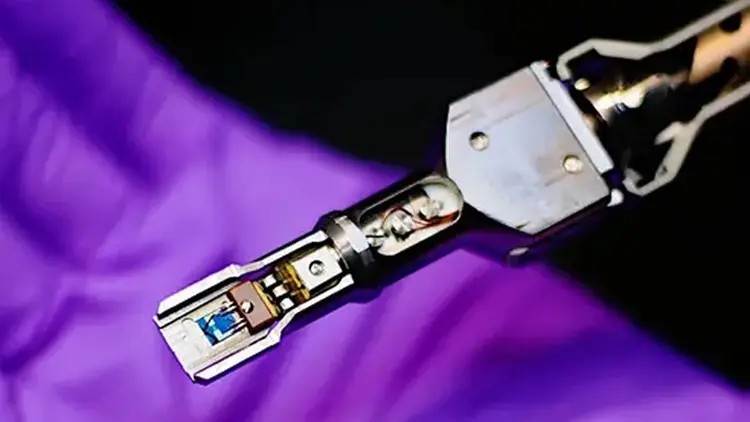
Figure 1. Transitional Phase.
This unique environment gives rise to an unusual state known as the hexatic phase. In this state, the spacing between atoms becomes disordered like a liquid, while the angles between neighboring atoms remain orderly, as in a solid. Essentially, the material becomes a shaky, partially ordered crystal—not fully solid and not fully liquid. Predicted in the 1970s, this hexatic phase has never been directly observed in a naturally bonded material—until now. Figure 1 shows Transitional Phase.
First real-world observation of 2D melting
Past experiments detected this phase only in artificial model systems—such as floating plastic beads—rather than real atomic materials. Theory predicts that 2D materials melt in two gradual stages: first from solid to hexatic, and then from hexatic to liquid.
To test this, the Vienna team studied an atom-thick layer of silver iodide (AgI) sealed between two graphene sheets. The graphene acted as both a stabilizer and heat shield, preventing the thin crystal from deforming [1]. Using a scanning transmission electron microscope, they heated the sample to 1100°C (2012°F) while capturing atomic-resolution video—something previously considered impossible. AI-powered neural networks then analyzed thousands of frames, tracking every atom’s movement.
A surprising twist to the theory
The team confirmed part of the existing model: the hexatic phase formed about 25°C (77°F) below the melting point. But the next stage defied expectations. Instead of melting gradually from hexatic to liquid, the transition happened suddenly—more like conventional 3D melting than the predicted smooth 2D behavior.
This abrupt shift overturns long-standing theories of 2D melting and suggests that the true behavior of ultrathin materials is far more complex than believed.
References:
- https://interestingengineering.com/science/scientists-track-every-atom-during-melting
Cite this article:
Keerthana S (2025), Scientists Trace Atoms in Real Time as They Melt, Uncovering A Never-Before-Seen Transitional Phase, AnaTechMaz, pp.311
Recent Post
-
Gigapascal Plasma Reached as FuZE3 Marks Major Fusion Milestone
Using its newest Fusion Z-pinch Experiment (FuZE-3), Zap Energy...
-

Compact Laser Technology Could Redefine Medical and Manufacturing Applications
Researchers have created a groundbreaking and adaptable ...
-

Chaotic Bubbles Validate a 100-Year-Old Physics Prediction
Researchers have discovered experimental proof that a fundamental theory of turbulence applies...
-
Ultra-Light, Ultra-Strong Material Survives 932°F — A Game-Changer for Aerospace
Researchers have created an exceptionally lightweight yet ....
-
Lithium Has Been Extracted from Discarded Batteries Using a Cost-Effective, Electrochemically Driven Recovery Process
Researchers in the United States...
-

Chinese Solid-State EV Battery Giant Wins Eight Patents for Future Battery Tech
Tinci’s newest patents signal rapid progress in solid-state....
-

1950s Material Is Making a Major Comeback—and Could Redefine Modern Computing
Researchers are exploring hole mobility in compressively strained ....
-
INL Marks a Milestone as First TRISO Fuel Shipment Arrives for Upcoming Demonstration Reactor
The United States has taken a significant step toward deploying its...
-
A Breakthrough Material for Buildings Can Store Carbon Instead of Emitting it
A new carbon-negative building material developed at...
-

Explained: Small Modular Reactors and Their Role in Supporting Rising Global Power Demand
Small modular reactors (SMRs) are quickly moving from ...
-
Scientists Trace Atoms in Real Time as They Melt, Uncovering A Never-Before-Seen Transitional Phase
Scientists have directly ....
-
MIT Study Sheds New Light on Proton Dynamics Inside Metal Oxides
As renewable energy technologies such as fuel cells and electrolyzers ...
-
Game-Changing Flexible Battery Material Promises 45% Boost in Drone and EV Range
A new battery manufacturing approach that avoids the use of explosive...
-
Nuclear Breakthrough: UK Converts First Can of Radioactive Plutonium into Stable Waste
The UK holds around 140 tonnes of plutonium, accumulated since...
-
Exciton Tomography Maps Electron-Hole Correlations in 2D Materials
Excitons—quasiparticles formed by bound electron-hole pairs—are key to understanding a material’s optical....