

Game-Changing Flexible Battery Material Promises 45% Boost in Drone and EV Range
A new battery manufacturing approach that avoids the use of explosive gases could significantly improve both the safety and performance of lithium-ion batteries, potentially extending the range of drones and electric vehicles by up to 45 percent.
Dallas-based Solidion Technology has unveiled a silicon-rich, high-capacity anode designed to deliver longer flight times for drones and greater driving range for electric vehicles—without relying on hazardous manufacturing methods such as chemical vapor deposition (CVD). By eliminating processes that use highly explosive gases, the company says its technique enhances safety while also lowering production costs.
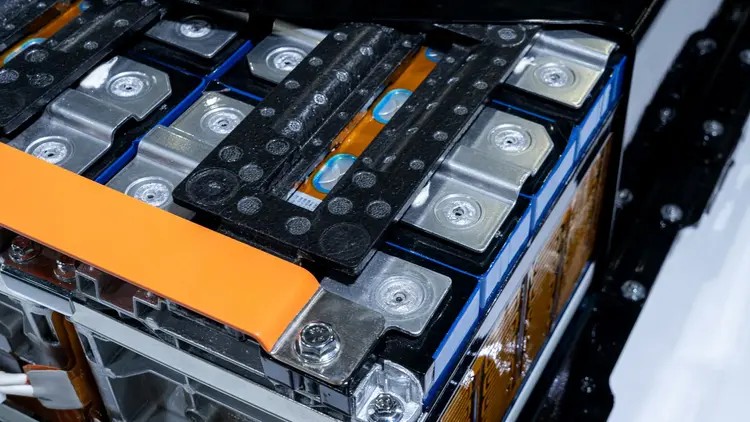
Figure 1. Lithium-Ion Batteries.
As countries accelerate efforts to combat climate change, the push toward renewable energy and electrified transport is driving unprecedented demand for energy storage. Lithium-ion batteries currently dominate this space, but rising energy density has also heightened safety risks, particularly related to overheating and thermal runaway. To sustain large-scale electrification, the industry must adopt technologies that increase capacity without compromising safety. Solidion’s latest anode design aims to meet that challenge. Figure 1 shows lithium-ion batteries.
Silicon-Rich Anodes, Made Flexible
Because lithium-ion batteries are already manufactured at scale, any major improvements must be both cost-effective and easy to integrate into existing production lines. Solidion’s solution uses a flexible, rubber-like matrix to incorporate high levels of silicon into the anode—an element known for its high energy capacity but notorious for causing structural instability in batteries.
According to the company, the anode’s spherical structure provides mechanical stability while maintaining long-term performance. The design is optimized to maximize lithium-ion utilization, resulting in higher energy output per charge.
The anode is built from a graphene–silicon composite blended with conventional graphite, allowing it to integrate smoothly into a wide range of anode architectures. Its compatibility with multiple binder types further enhances its versatility for manufacturers.
Safer Manufacturing, Longer Range
Traditional methods for producing high-capacity battery electrodes often rely on CVD processes that use dangerous gases such as silane. These materials not only pose safety risks—especially during thermal runaway events—but also increase manufacturing complexity and cost.
Solidion’s silane-free process avoids these issues entirely. Encapsulating silicon within the anode improves stability, while eliminating CVD reduces both risk and expense [1]. Additional cost savings come from using metallurgical-grade silicon or reclaimed silicon as raw materials.
The company’s patented technology can produce anodes containing 45 to 95 percent silicon by weight, a dramatic increase over conventional designs. This high silicon content translates directly into improved performance, with Solidion estimating range gains of 20 to 45 percent for applications such as drones and electric vehicles.
Crucially, the technology is compatible with both liquid and solid electrolytes, meaning it could remain relevant even as the industry transitions toward solid-state batteries.
Built for the future
In addition to its silicon-rich anodes, Solidion also offers silicon-oxide and graphite-based materials. With global graphite demand expected to outpace supply in coming years, the company has developed a synthetic graphite alternative that is already being used in its anode products.
By combining safer manufacturing, lower costs, and substantial performance gains, Solidion’s flexible anode technology points to a future where lithium-ion batteries deliver longer range without increasing risk.
References:
- https://interestingengineering.com/energy/silicon-rich-anodes-boosts-range
Cite this article:
Keerthana S (2025), Game-Changing Flexible Battery Material Promises 45% Boost in Drone and EV Range, AnaTechMaz, pp.313
Recent Post
-
Gigapascal Plasma Reached as FuZE3 Marks Major Fusion Milestone
Using its newest Fusion Z-pinch Experiment (FuZE-3), Zap Energy...
-
Compact Laser Technology Could Redefine Medical and Manufacturing Applications
Researchers have created a groundbreaking and adaptable ...
-

Chaotic Bubbles Validate a 100-Year-Old Physics Prediction
Researchers have discovered experimental proof that a fundamental theory of turbulence applies...
-
Ultra-Light, Ultra-Strong Material Survives 932°F — A Game-Changer for Aerospace
Researchers have created an exceptionally lightweight yet ....
-
Lithium Has Been Extracted from Discarded Batteries Using a Cost-Effective, Electrochemically Driven Recovery Process
Researchers in the United States...
-

Chinese Solid-State EV Battery Giant Wins Eight Patents for Future Battery Tech
Tinci’s newest patents signal rapid progress in solid-state....
-
1950s Material Is Making a Major Comeback—and Could Redefine Modern Computing
Researchers are exploring hole mobility in compressively strained ....
-
INL Marks a Milestone as First TRISO Fuel Shipment Arrives for Upcoming Demonstration Reactor
The United States has taken a significant step toward deploying its...
-

A Breakthrough Material for Buildings Can Store Carbon Instead of Emitting it
A new carbon-negative building material developed at...
-

Explained: Small Modular Reactors and Their Role in Supporting Rising Global Power Demand
Small modular reactors (SMRs) are quickly moving from ...
-
Scientists Trace Atoms in Real Time as They Melt, Uncovering A Never-Before-Seen Transitional Phase
Scientists have directly ....
-
MIT Study Sheds New Light on Proton Dynamics Inside Metal Oxides
As renewable energy technologies such as fuel cells and electrolyzers ...
-
Game-Changing Flexible Battery Material Promises 45% Boost in Drone and EV Range
A new battery manufacturing approach that avoids the use of explosive...
-
Nuclear Breakthrough: UK Converts First Can of Radioactive Plutonium into Stable Waste
The UK holds around 140 tonnes of plutonium, accumulated since...
-
Exciton Tomography Maps Electron-Hole Correlations in 2D Materials
Excitons—quasiparticles formed by bound electron-hole pairs—are key to understanding a material’s optical....