

AI Takes Imaging to the Edge of What Physics Allows
How accurately can you measure an object when all you have is a blurred image? Scientists at TU Wien, in collaboration with teams from the University of Glasgow and the University of Grenoble, have pushed the boundaries of what is physically possible—using artificial intelligence.
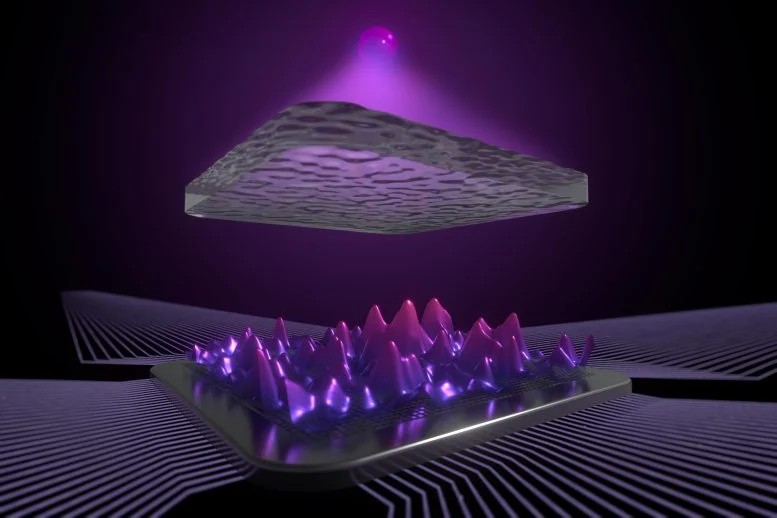
Figure 1. Edge of What Physics Allows.
The Fundamental Challenge of Blur
No imaging system, no matter how advanced, can completely eliminate blur. For more than 150 years, researchers have known that microscopes and cameras are bound by fundamental physical limits—rooted not in technology, but in the very nature of light itself. This means pinpointing an object’s exact location with infinite precision is physically impossible. Figure 1 shows edge of what physics allows.
Given this, the international research team set out to explore the ultimate precision optical systems can achieve. More importantly, they asked: can AI help us reach that theoretical limit? Their answer: yes—nearly. By training neural networks on complex light patterns, they’ve developed a method that comes astonishingly close to this boundary [1]. The technique is now being considered for real-world applications in fields like medical imaging.
Imaging Through Complexity
“Imagine trying to spot a small object behind a fogged-up or irregular glass pane,” explains Prof. Stefan Rotter of TU Wien. “Instead of a clear image, you see a chaotic pattern of light and dark patches. The question becomes: how accurately can we locate the object based on this scattered pattern—and what’s the best accuracy physics allows?”
This question isn’t just theoretical—it’s critical in real-world situations like biomedical imaging, where light is scattered unpredictably by tissue. Even when the data appears chaotic, can some meaningful information still be extracted?
To answer this, the team used a key concept from information theory: Fisher information, which quantifies how much data a signal carries about an unknown variable, such as position. If Fisher information is low, no algorithm, no matter how advanced, can provide accurate estimates. Using this concept, the researchers calculated the absolute upper bound of possible measurement precision for different scenarios.
Teaching AI to Decode Light Chaos
While TU Wien tackled the theory, researchers at Grenoble and Glasgow designed a real-world experiment. A laser beam was directed at a reflective object behind a turbid fluid, producing images of heavily distorted light patterns. The level of image distortion varied with the cloudiness of the fluid.
“To the human eye, these images look completely random,” says Maximilian Weimar, co-author from TU Wien. “But if you train a neural network with thousands of these images—each labeled with the object’s known position—the network begins to recognize subtle correlations.”After training, the AI could infer object positions with surprising accuracy, even from unseen patterns.
Approaching the Unbreakable Limit
Most impressively, the AI's accuracy came remarkably close to the theoretical limit set by Fisher information. “Our AI system isn’t just good—it’s nearly optimal,” says Rotter. “It achieves precision that is virtually at the edge of what physics allows.”
A Future for Ultra-Precise AI Imaging
This breakthrough has the potential to revolutionize optical measurement in fields like diagnostics, materials science, and quantum sensing. The researchers now plan to collaborate with applied physicists and medical experts to bring these AI-driven techniques into practical use.
As this study shows, combining physics with artificial intelligence doesn’t just make our tools smarter—it lets us stretch them to the very edge of possibility.
Reference:
- https://scitechdaily.com/ai-pushes-imaging-to-the-absolute-brink-of-physical-limits/
Cite this article:
Keerthana S (2025), AI Takes Imaging to the Edge of What Physics Allows, AnaTechMaz, pp.759
Recent Post
-

Revolutionary AI Tool Transforms the Future of Protein Engineering
In this study, researchers introduced AiCEsingle, a specialized module engineered to.....
-

Meta Patches Bug That May Have Exposed Users' AI Prompts and Outputs
Meta has resolved a security vulnerability that allowed users...
-
XAI Claims Grok 4's Response Issues Have Been Resolved
When xAI launched Grok 4 last week, it claimed the model outperformed its competitors on...
-

DuckDuckGo Now Offers Option to Hide AI-Generated Images in Search Results
Privacy-first browser DuckDuckGo is introducing a new feature that allows...
-

AI Uncovers 86,000 Hidden Earthquakes Beneath Yellowstone
Yellowstone, America’s first and one of its most iconic national parks, is renowned...
-
Amazon Acquires Bee, The Always-on AI Wearable That Records Your Conversations
Amazon has acquired Bee, an AI wearables startup, as confirmed in...
-

AI Cracks the Hidden Code of Gut Bacteria Communication
The human body is made up of about 30 to 40 trillion cells—but your gut hosts nearly...
-

Google Pilots a Vibe–Coding App Called Opal
AI-powered coding tools have surged in popularity in recent months, prompting nearly...
-
AI Takes Imaging to the Edge of What Physics Allows
How accurately can you measure an object when all you have is a blurred image? Scientists...
-

New GPT-OSS Model by NVIDIA And OpenAI Sets Record With 1.5 million Tokens Per Second
OpenAI and NVIDIA have jointly introduced two powerful...
-

Google’s Genie 3 Breathes Life Into AI-Generated Worlds with Dynamic, Real-Time Gameplay
World models like Genie 3 are seen as vital stepping stones on the path...
-

OpenAI Brings Back GPT-4o After User Backlash Over Complaints That the New GPT-5 Feels Less Intelligent
OpenAI rolled out its ...
-

Hexaware Technologies to Establish South African Hub for Delivering AI-Driven Solutions Across Africa
“South Africa has always been a key hub for IT transformation and serves...
-

Google Confronts $34.5 Billion Threat as AI Challenger Perplexity Targets Chrome
In a dramatic David-and-Goliath play, Perplexity AI has made an...
-

AI-Powered Radar Can Eavesdrop on Phone Calls from 10 Feet Away, Raising Fresh Privacy Concerns
Your phone’s smallest vibrations may be giving away your conversations...
-