

Physicists Find a New Method to Link Qubits Using Crystal Defects
A Collaborative, Computation-Driven Approach
Backed by Air Force funding, the project brought together researchers from the University of Chicago and Ohio State, uniting expertise in materials science, mechanical engineering, quantum information science, and high-performance computing.
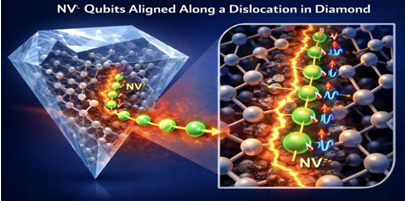
Figure 1. Crystal Defects Unlock a New Way to Connect Qubits.
The team’s simulations relied on GPU-accelerated, massively parallel tools developed by the Midwest Integrated Center for Computational Materials (MICCoM). Based at Argonne National Laboratory and funded by the U.S. Department of Energy, MICCoM—directed by Galli—provided the advanced software needed to model the intricate behavior of quantum defects linked to crystal dislocations at an unprecedented level of detail.Figure 1 shows Crystal Defects Unlock a New Way to Connect Qubits.
“These large-scale, first-principles calculations allowed us to accurately capture the complex quantum properties of defects along one-dimensional dislocation cores,” said co-first author Victor Yu, a staff scientist at Argonne and MICCoM principal investigator.
The researchers found that many nitrogen-vacancy (NV) centers located near dislocation cores remain stable in the desired charge and spin states while maintaining a functional optical cycle, enabling reliable optical initialization and spin readout.
“Crucially, our predictions show that certain NV configurations near dislocations have markedly longer quantum coherence times than those in pristine diamond,” said Ghazisaeidi.
This enhancement stems from symmetry breaking near the dislocation, which gives rise to special “clock transitions” that shield the qubit from environmental magnetic noise.
Guiding Experiments and Shaping Future Devices
In addition to confirming stability and coherence, the study provided detailed predictions of optical and magnetic resonance signatures, offering experimentalists a roadmap to identify NV–dislocation configurations suitable for quantum applications.
“Not every defect arrangement is ideal for quantum operations, but our results indicate that a significant fraction meet the criteria for functional qubits,” said co-author Yu Jin, who conducted the research as a graduate student at UChicago and is now a postdoctoral fellow at the Flatiron Institute in New York.
Taken together, the findings introduce a new paradigm for quantum device design: treating dislocations not as flaws to be eliminated, but as quantum highways that can host and connect chains of interacting qubits. This strategy opens the door to scalable quantum interconnects in diamond—and potentially other materials—offering a promising route for next-generation solid-state quantum technologies.
Source: SciTECHDaily
Cite this article:
Priyadharshini S (2026), Physicists Find a New Method to Link Qubits Using Crystal Defects”, AnaTechMaz, pp.449
Recent Post
-

Fermilab and Qblox Collaborate to Advance Quantum Research and Training
Fermilab, in partnership with Qblox and supported by the U.S. Department...
-

Quantum Computing Threat Spurs Preparations for Future Cyberattacks
Sharon Dolmans, an associate professor in Industrial...
-

Fermilab and Qblox Collaborate to Advance Quantum Research and Training
Fermilab, in partnership with Qblox and supported by the U.S....
-

Quantum and High-Throughput Computing Enable Molecular Resonance Discovery with Integrated qDRIVE
Researchers have introduced a powerful hybrid...
-

Silicon Processor Connects 11 Qubits with Over 99% Fidelity
Scaling up quantum computers requires adding and interconnecting more qubits, but ...
-

Quantum Internet Advances with 100 km Secure Communication Breakthrough
One of the main technical obstacles in quantum...
-
Revolutionary Cooling Method Could Redefine Quantum Computer Design
s quantum computers scale up with more qubits to tackle...
-
Scientists Transform Ordinary Glass into a High-Speed Quantum Security Device
Continuous-variable (CV) quantum information processing...
-

Caltech Achieves Fiber-Optic–Level Performance on Silicon Chips
To create the light-guiding structures—called waveguides, which are nanoscale pathways that...
-
Scientists Develop “Levitating” Time Crystals That Challenge the Laws of Physics
The time crystal is composed of tiny Styrofoam beads...
-

Scientists Uncover Unexpected Quantum Behavior in a Common Element
To investigate these phenomena, the team employed spin...
-

Quantum Microchip Simulated in Exceptional Detail Using 7,000 GPUs
Designing quantum chips involves integrating well-established...
-
Quantum Chaos Yields a Surprising Superconductivity “Hidden Order”
Superconductivity has fascinated scientists for decades due to its potential to revolutionize...
Physicists Find a New Method to Link Qubits Using Crystal Defects
Backed by Air Force funding, the project brought...

Exploring the Effects of Extra Dimensions on Light
Quantum structured light is paving the way for breakthroughs in imaging and metrology. Researchers...