

Researchers Achieve Hybrid Spin Sound Waves That Could Support Advanced 6G
A recent study has demonstrated strong coupling between sound waves and spin waves in yttrium iron garnet, marking a promising step toward adaptive 6G communication technology. Acoustic frequency filters already help smartphones distinguish between cellular signals, Wi-Fi, and GPS. Now, researchers at RPTU Kaiserslautern-Landau report a new physical effect that could influence how future wireless systems operate.
Their work shows that miniature sound waves can tightly interact with spin waves inside yttrium iron garnet, forming hybrid excitations in the gigahertz range. This breakthrough points toward tunable, compact signal filters tailored for upcoming 6G standards.
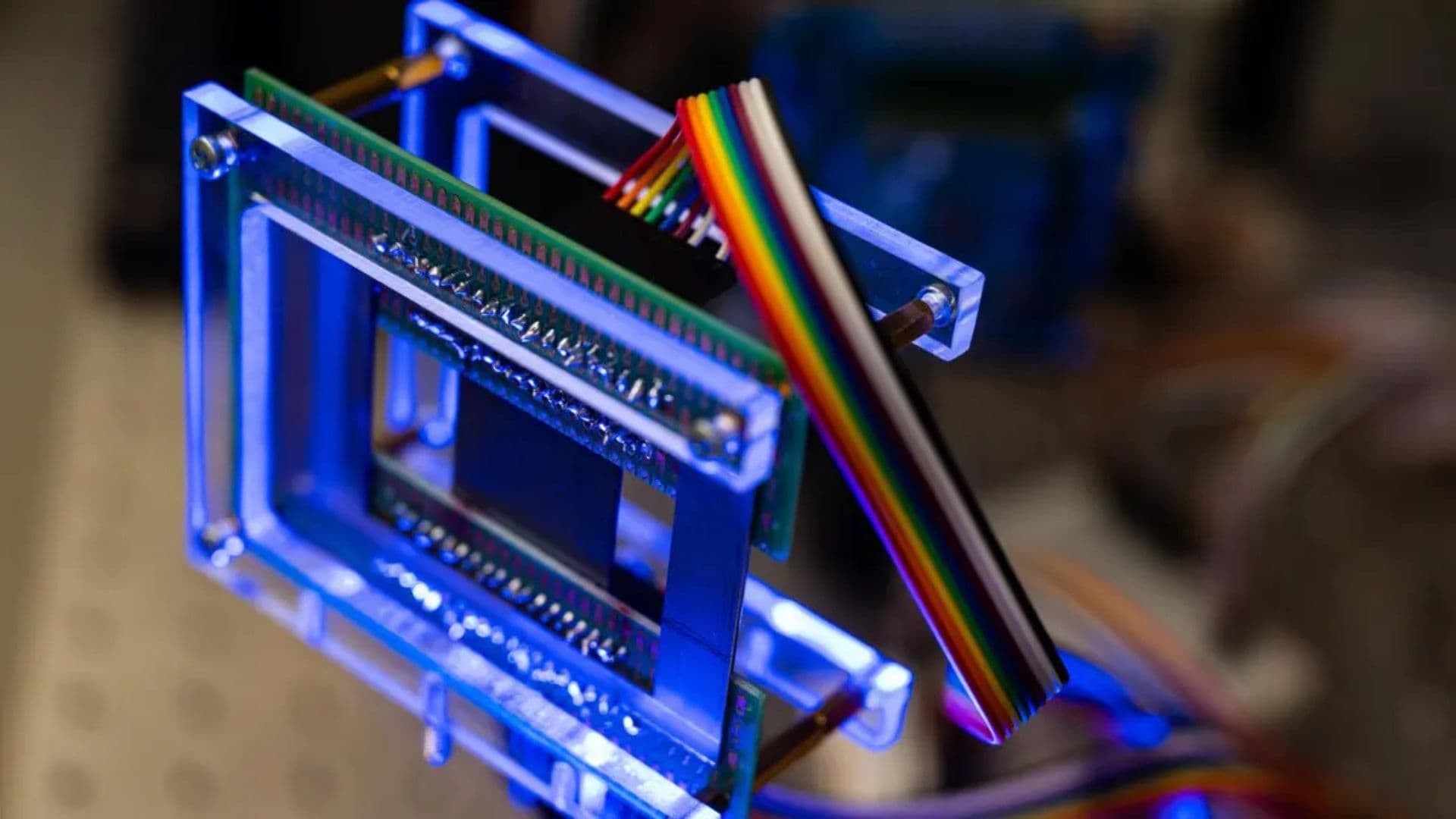
Figure 1. Hybrid Spin Sound.
Extending Surface Acoustic Wave Technology
Surface acoustic waves (SAWs), widely used in today’s mobile electronics and naturally occurring in earthquakes, are the foundation of this research. Professor Mathias Weiler’s team aims to merge this established technology with spin physics to unlock new capabilities.
“Sound waves travel not only through air but also through solid materials, where lattice atoms vibrate,” Weiler explained [1]. Since electrons in these atoms carry quantum spin, they can respond to these oscillations when the material is magnetically ordered—allowing sound waves to trigger spin waves.
The team selected yttrium iron garnet, a ferrimagnetic insulator prized for its long spin-wave lifetime, making it ideal for studying interactions at the nanoscale. Experiments revealed the formation of hybrid excitations—known as magnon polarons—inside a nanoscale acoustic surface resonator.
First author Kevin Künstle described the result: “We saw that quantum coupling between spin and sound produces a new kind of wave that is neither purely acoustic nor purely magnetic. Instead, both components are inseparably merged.”
These hybrid waves continuously switched between sound-like and spin-like states at a rate known as the Rabi frequency. In this system, the frequency exceeded all loss mechanisms, confirming the presence of a strong coupling regime. A complementary theoretical model developed with Professor Akashdeep Kamra’s group further validated and clarified the observations.
Toward Reconfigurable 6G Hardware
The researchers say the discovery unites two foundational microwave technologies. “Our hybrid spin–sound excitations bring together acoustic filters and ferrimagnetic materials,” Weiler noted. He suggested that this could eventually lead to frequency filters capable of adjusting themselves in real time—an important feature for flexible and adaptive 6G communication systems.
If successfully developed into devices, these hybrid waves may help enable future wireless networks that rely on smarter, dynamically controlled signal pathways.
Reference:
- https://interestingengineering.com/innovation/hybrid-spin-sound-waves-6g
Cite this article:
Keerthana S (2025), Researchers Achieve Hybrid Spin Sound Waves That Could Support Advanced 6G, AnaTechMaz, pp.247
Recent Post
-

Edge Stepper Router Implant Exploits Software Update Mechanisms to Deploy Malware
ESET researchers have identified a new adversary-in-the....
-

New Fingerprinting Resistance Measures Launched in Firefox Version 145
Mozilla has begun releasing Firefox 145, introducing....
-

China Tests Starlink Jamming Tactics Over Taiwan, Deploying 1,000+ Drones
Chinese military analysts are shifting their focus from the....
-
Leo Ultra Joins Satellite Internet Battle, Promising 1Gbps Service to Challenge Starlink
Amazon has taken a significant step toward the commercial....
-

A Critical Web assembly Vulnerability in Firefox Remained Unnoticed for Six Months
A serious memory corruption vulnerability in Firefox’s....
-

Free Tool Lets Users Check Whether Their IP Address Has Been Linked to Malicious Activity
Grey Noise has released a free online tool that allows....
-
Researchers Achieve Hybrid Spin Sound Waves That Could Support Advanced 6G
A recent study has demonstrated strong coupling between....
-

Star Catcher Sets New Benchmark in Wireless Power Beaming, Surpassing DARPA Record
Star Catcher Industries has achieved a new milestone in....
-

Apstra Founder Unveils Aria to Boost AI Network Performance
A growing number of networking startups are tackling the unique challenges posed by AI....
-

AIOZ Network: Creating an Internet Powered by People
The promise of Web2 was democratization—the idea that anyone with a computer could ....
-

Amazon’s Satellite Network Rebrands, Moves Away from Low-Cost Focus
Amazon’s emerging satellite internet program has dropped....
-

Exploring Networks, Artificial Intelligence, and the Metaverse
Enterprises must plan for the future, and the trajectory of AI matters far beyond AI itself.....
-

Scientists Achieve First-Ever Entanglement Teleportation Between Connected Quantum Networks
Researchers have, for the first time....
-
Mlipaudit Benchmarks ML Interatomic Potentials for Precise, Efficient Simulations
The growing need for accurate yet efficient atomistic....
-
Quantum Hybrid Systems Show Photon-Tunneling Modulation Across Four Chiral States
Researchers are advancing nanoscale light control by inves....