

Leo Ultra Joins Satellite Internet Battle, Promising 1Gbps Service to Challenge Starlink
Amazon has taken a significant step toward the commercial debut of its satellite internet service next year, unveiling Leo Ultra, its most advanced antenna to date, and opening an enterprise preview program for select customers. The announcement signals that Amazon Leo—formerly known as Project Kuiper—is shifting from deployment toward full commercial readiness, backed by a growing constellation of more than 150 satellites already in orbit.
High-Performance Hardware for Enterprise and Government
Positioned as the flagship model in Amazon’s three-antenna portfolio, Leo Ultra is designed for demanding business and government applications. The 20-by-30-inch terminal delivers download speeds up to 1Gbps and 400Mbps uploads, which Amazon describes as the fastest commercial phased-array antenna currently in production. Its solid-state design eliminates moving parts, enabling quick installation and durability in harsh environmental conditions.
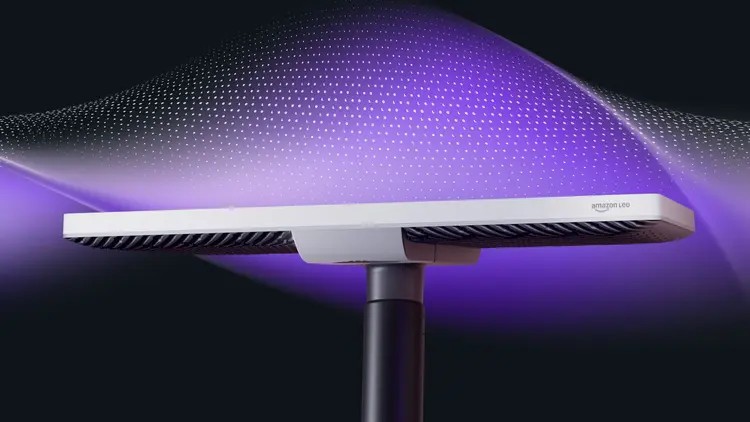
Figure 1. Leo Ultra Joins Satellite.
“Amazon Leo represents a massive opportunity for businesses operating in challenging environments,” said Chris Weber, vice president of consumer and enterprise business for Amazon Leo. He emphasized that the company engineered both the satellite network and hardware lineup specifically to meet complex enterprise and government requirements. Figure 1 shows Leo Ultra Joins Satellite.
Powered by custom silicon, proprietary RF design, and advanced signal-processing algorithms, the system reduces latency and increases bandwidth for cloud computing, video conferencing, and real-time monitoring. The hardware integrates directly into existing enterprise networks and supports simultaneous bidirectional connections.
Airline JetBlue is among the early partners exploring the technology for faster in-flight Wi-Fi. “Amazon Leo shares our passion for customer-first innovation,” said Marty St. George, JetBlue president, citing performance and flexibility as core considerations.
Built for Private and Secure Networking
Amazon Leo will feature end-to-end encryption, management tools, and 24/7 priority support. Unlike many existing satellite services, the system can connect directly into AWS or on-premise infrastructure without touching the public internet.
Two core private networking options will be available:
- Direct to AWS — links terminals to cloud workloads via a browser console and supports AWS Transit Gateway and Direct Connect Gateway
- Private Network Interconnect — provides dedicated links through key colocation hubs, reducing setup time from months to days
Security is a major selling point after recent academic research revealed serious vulnerabilities in older GEO satellite systems that leaked VoIP calls, login credentials, and corporate email over unencrypted channels [1]. Amazon positions its private networking architecture as a direct answer to those shortcomings.
Target Markets and Competitive Landscape
Amazon says it has already secured partners across aviation, energy, logistics, and agriculture, and the enterprise preview is now delivering Leo Pro and Leo Ultra hardware to initial users.
“The combination of Amazon Leo bandwidth and secure private links is exactly what we needed,” said Hunter Hunt, CEO of Hunt Energy Holdings and chairman of Skyward.
The preview will expand as additional satellites join the network, with full commercial availability expected next year—entering a market currently dominated by SpaceX’s Starlink. Amazon claims faster peak speeds than Starlink’s current business tier, although SpaceX is preparing a major V3 hardware upgrade.
Reference:
- https://interestingengineering.com/space/amazon-leo-ultra-satellite-internet
Cite this article:
Keerthana S (2025), Leo Ultra Joins Satellite Internet Battle, Promising 1Gbps Service to Challenge Starlink, AnaTechMaz, pp.244
Recent Post
-
Edge Stepper Router Implant Exploits Software Update Mechanisms to Deploy Malware
ESET researchers have identified a new adversary-in-the....
-

New Fingerprinting Resistance Measures Launched in Firefox Version 145
Mozilla has begun releasing Firefox 145, introducing....
-
China Tests Starlink Jamming Tactics Over Taiwan, Deploying 1,000+ Drones
Chinese military analysts are shifting their focus from the....
-
Leo Ultra Joins Satellite Internet Battle, Promising 1Gbps Service to Challenge Starlink
Amazon has taken a significant step toward the commercial....
-
A Critical Web assembly Vulnerability in Firefox Remained Unnoticed for Six Months
A serious memory corruption vulnerability in Firefox’s....
-

Free Tool Lets Users Check Whether Their IP Address Has Been Linked to Malicious Activity
Grey Noise has released a free online tool that allows....
-

Researchers Achieve Hybrid Spin Sound Waves That Could Support Advanced 6G
A recent study has demonstrated strong coupling between....
-

Star Catcher Sets New Benchmark in Wireless Power Beaming, Surpassing DARPA Record
Star Catcher Industries has achieved a new milestone in....
-

Apstra Founder Unveils Aria to Boost AI Network Performance
A growing number of networking startups are tackling the unique challenges posed by AI....
-

AIOZ Network: Creating an Internet Powered by People
The promise of Web2 was democratization—the idea that anyone with a computer could ....
-

Amazon’s Satellite Network Rebrands, Moves Away from Low-Cost Focus
Amazon’s emerging satellite internet program has dropped....
-

Exploring Networks, Artificial Intelligence, and the Metaverse
Enterprises must plan for the future, and the trajectory of AI matters far beyond AI itself.....
-

Scientists Achieve First-Ever Entanglement Teleportation Between Connected Quantum Networks
Researchers have, for the first time....
-

Mlipaudit Benchmarks ML Interatomic Potentials for Precise, Efficient Simulations
The growing need for accurate yet efficient atomistic....
-
Quantum Hybrid Systems Show Photon-Tunneling Modulation Across Four Chiral States
Researchers are advancing nanoscale light control by inves....