

Researchers Create Scalable Repeaters for Long-Distance Internet Communication
Quantum repeaters are essential for enabling secure, long-distance communication, but building practical devices has been a major challenge. Researchers Javier Rey-Domínguez and Mohsen Razavi from the University of Leeds, along with their team, have proposed a new approach that balances scalability with the constraints of existing infrastructure. Their design addresses the limitations of early repeaters, which are hard to scale, and advanced systems, which require impractical hardware. The team introduces a connectionless swapping method—inspired by internet packet switching—and focuses on simple error detection rather than complex correction, resulting in a more feasible and scalable system. This strategy could enable secure, continental-scale quantum key distribution and represents a step toward a functional quantum internet.
Designing quantum repeaters is challenging because early solutions often fail to scale, while advanced designs require major changes to telecom infrastructure. This research proposes a compromise approach that is both scalable over the mid- to long term and compatible with existing Internet backbone networks. The system uses a connectionless entanglement swapping method, similar to packet-switched networks, and relies on simple error detection, providing a practical route toward robust quantum communication.
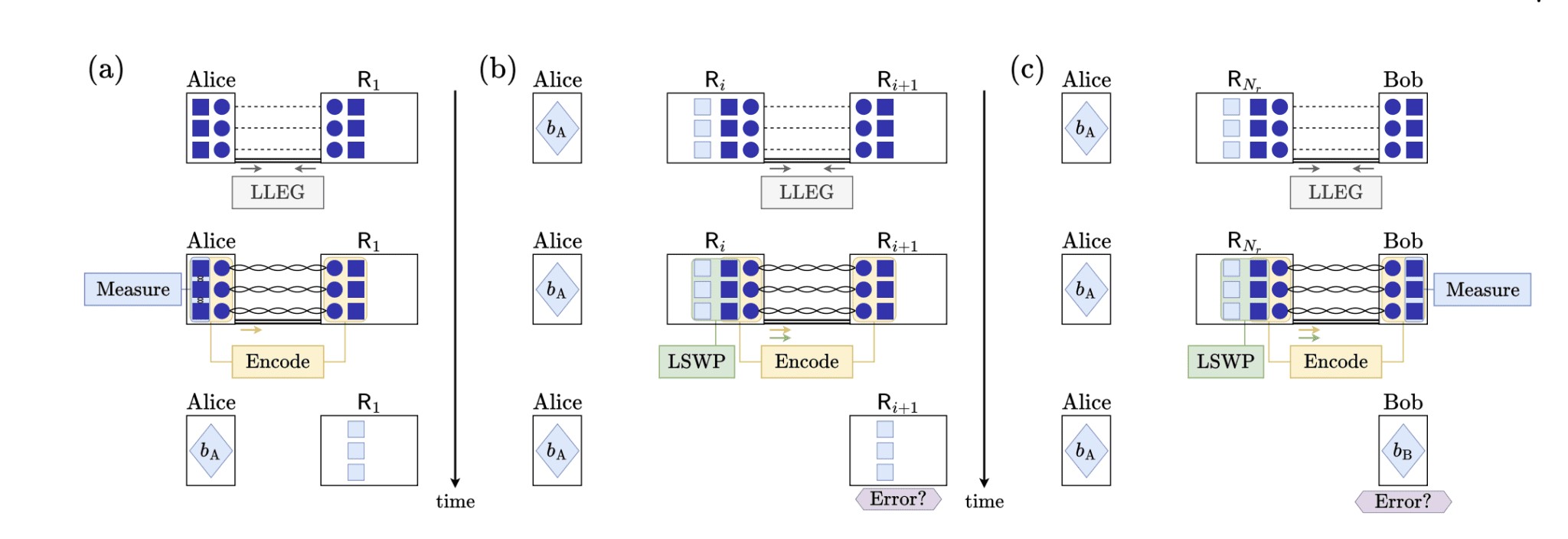
Figure 1. Scalable Quantum Repeaters for Long-Distance Networks
Scalable Quantum Repeaters for Long-Distance Communication
Establishing long-distance quantum communication is challenging because quantum signals weaken and degrade over distance. Quantum repeaters are essential for extending the range of secure quantum communication by creating entangled pairs of qubits, the fundamental units of quantum information. Entanglement swapping, performed via Bell state measurements, allows this entanglement to stretch across longer distances. However, maintaining entanglement is difficult due to memory decoherence, where quantum information is lost to the environment, making effective error detection and correction critical. Figure 1 shows Scalable Quantum Repeaters for Long-Distance Networks.
Researchers have explored various quantum repeater protocols, each with different methods for entanglement generation and swapping. One notable approach, Sequential Entanglement Generation with Error Detection (SEG-ED), builds entanglement step-by-step along a communication path, unlike parallel methods that attempt entanglement across the full distance simultaneously. SEG-ED emphasizes simplicity by focusing on error detection rather than complex correction, reducing hardware requirements. Other protocols use probabilistic swapping with linear optics, generating entanglement with a certain probability and characterized by parameters such as the Werner parameter.
The choice of quantum repeater protocol involves balancing scalability, fidelity, and resource demands. Protocols differ mainly in their methods for entanglement generation, error management, and implementation complexity. Sequential protocols provide a more manageable setup, while parallel protocols can enable faster communication. Focusing on error detection simplifies hardware but may lower overall fidelity. The objective is to identify the most promising strategies for constructing a practical long-distance quantum network while weighing performance against complexity.
Scalable Quantum Repeaters via Sequential Entanglement Generation
Researchers have introduced a new quantum repeater protocol, Sequential Entanglement Generation with Error Detection (SEG-ED), designed to overcome challenges in long-distance quantum communication. The protocol balances scalability and practical implementation, making it compatible with existing network infrastructure while supporting future quantum networks. It focuses on efficiently distributing entangled states, a critical step for secure quantum key distribution and distributed quantum computing.
Unlike conventional protocols that generate entanglement in parallel—which can be inefficient under variable network demands—SEG-ED employs a sequential hop-by-hop approach, releasing resources after each step to optimize allocation and adapt to network traffic. Its key innovation lies in error handling, emphasizing simple error detection rather than complex correction. By detecting errors early and aborting the distribution process when needed, the protocol frees resources for other users, enhancing overall network efficiency.
This approach harnesses the advantages of encoded quantum repeaters while avoiding the heavy computational demands of full error correction. Analysis indicates that SEG-ED’s feasibility depends on balancing error resilience with achievable communication rates and distances; excessive noise could lead to frequent aborts, undermining the protocol. Nevertheless, the researchers’ results suggest that SEG-ED provides a promising route toward practical, scalable quantum communication networks, compatible with modern Internet architecture and existing infrastructure.
Error-Detecting Quantum Repeaters for Scalable Communication
This study introduces a practical quantum repeater protocol, Sequential Entanglement Generation with Error Detection (SEG-ED), aimed at enhancing long-distance quantum communication. The method combines sequential entanglement generation with simple error detection, striking a balance between complex, resource-heavy solutions and those lacking scalability. It improves compatibility with existing classical networks through statistical multiplexing and shows potential for efficient resource use in targeted scenarios. Results indicate that SEG-ED can achieve near- to mid-term scalability with relatively simple error correction codes while maintaining acceptable performance in realistic network topologies [1]. Although the current analysis focuses on a single communication path, the researchers note the protocol’s potential for multi-user networks, offering advantages in fairness and cost efficiency. Further research is needed to evaluate performance under high-traffic conditions and explore integration with hybrid quantum networks combining terrestrial and satellite links.
References:
- https://quantumzeitgeist.com/researchers-develop-scalable-repeaters-for-long-distance-communication-adapting-to-current-internet-infrastructure/
Cite this article:
Janani R (2025), Researchers Create Scalable Repeaters for Long-Distance Internet Communication, AnaTechMaz, pp. 227
Recent Post
-
Researchers Tackle Vanishing Gradients in Deep RNNs with Equilibrium Propagation
Equilibrium Propagation (EP) is emerging as a....
-
Researchers Create Scalable Repeaters for Long-Distance Internet Communication
Quantum repeaters are essential for enabling secure....
-
Scientists Warn: New WIFI Technology Can Identify People Without Their Devices
Researchers at the Karlsruhe Institute of Technology (KIT) have...
-

Surfshark Unveils Ultra-Fast 100 Gbps VPN Servers, Setting New Speed Benchmark
Surfshark has announced the deployment of 100 Gbps servers.....
-

Advanced Online Protection: Essential Tools for Modern Internet Security
In an era where cyber threats are smarter, stealthier, and...
-

Mississippi’s Age Verification Law Challenges Decentralized Social Networks
A sweeping new age assurance law in Mississippi has sparked debate over....
-

Cisco: AI Drives Need for More Dependable Optical Networking Components
Cisco warns that as AI-driven networks increasingly rely...
-

Digital Twin Technology for Networks Encounters Challenges
By leveraging digital twin technology, network teams can model complex networks in software...
-

California Reduces the Impact of Ads on Streaming Platforms
California lawmakers are dialing down the volume on streaming ads. On October 6, Gov. Gavin Newsom...
-

OceanGate’s ‘Titan’ Made 7 Dives with a Compromised Hull Before Imploding
The U.S. National Transportation Safety Board (NTSB) has concluded...
-

Scientists Propose Quantum Network to Uncover the Universe’s Missing Matter
The team explored various network architectures — including...
-

IBM Broadens its Professional Service Offerings for Cisco Firewall Solutions
IBM Technology Lifecycle Services (TLS) has added Cisco’s...
-

Arista Expands its Networking Portfolio with AI Solutions
The company is growing its R4 family of high-capacity devices with several new additions: the 7020...
-

Enhancing Protection Through an Integrated Security and Networking Platform
As networks evolve, the traditional perimeter has vanished. Every...
-

Google and the U.S. government clash over the future of online advertising
Google is preparing to face the U.S. government in federal...