

Solar-Powered Eye Implant Brings Back the Gift of Reading Vision
A revolutionary electronic eye implant has enabled people blinded by dry age-related macular degeneration (AMD) to regain their reading vision — a medical first that’s reshaping the future of artificial sight.
In a landmark European trial, participants fitted with the PRIMA retinal implant and augmented-reality (AR) glasses were able to see letters, numbers, and words for the first time in years. Published in The New England Journal of Medicine, the study revealed that 84% of patients recovered functional reading ability using the device in an eye that had previously gone blind due to geographic atrophy, the advanced stage of dry AMD.
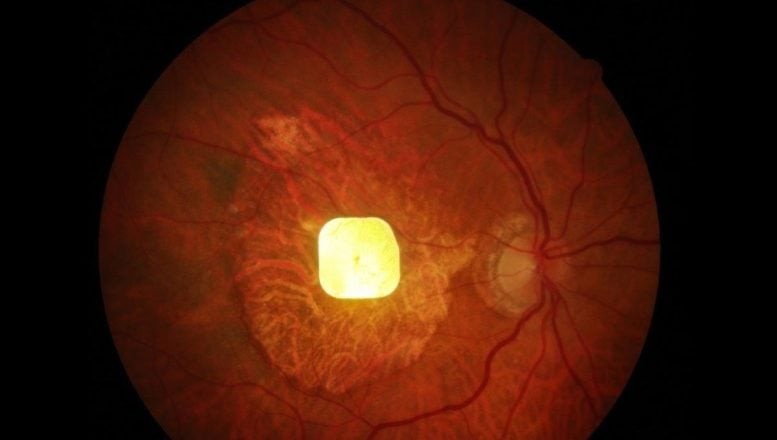
Figure 1. Solar-Powered Retinal Chip.
Before surgery, many could not see a vision chart at all; after implantation, most could read up to five lines. The clinical trial involved 38 participants across 17 hospitals in five European countries, with Moorfield’s Eye Hospital in London leading the UK arm of the research.
Dry AMD slowly destroys the macula, the part of the retina responsible for central, detailed vision. As retinal cells die, central sight fades, leaving only peripheral vision. Affecting roughly five million people worldwide, the condition currently has no approved treatment. Figure 1 shows Solar-Powered Retinal Chip.
A Breakthrough in Artificial Vision
The PRIMA implant marks a turning point in ophthalmology — the first device proven to restore central vision and reading capability.
“This is a new era in artificial vision,” said Mr. Mahi Muqit, associate professor at the UCL Institute of Ophthalmology and senior consultant at Moorfield’s Eye Hospital. “For the first time, blind patients are regaining meaningful central vision. The ability to read again transforms their confidence, independence, and quality of life.”
He added that the PRIMA operation takes less than two hours and can be performed by any trained vitreoretinal surgeon, paving the way for wider global adoption.During the surgery, doctors perform a vitrectomy—removing the gel inside the eye—and place a 2mm x 2mm microchip, thinner than a strand of hair, beneath the central retina.
How the System Works
After recovery, patients wear AR glasses equipped with a miniature camera linked to a waist-mounted computer. The glasses project infrared light onto the chip, which acts as a tiny solar panel, converting the light into electrical signals. These signals are processed by AI algorithms and sent through the optic nerve to the brain, where they are interpreted as visual images.
Patients then undergo months of vision rehabilitation, learning to interpret these new signals and use zoom features to read text or recognize objects.
The Science Behind the PRIMA Chip
Developed by Science Corporation (science.xyz), the PRIMA System combines neural engineering with solar power [1]. The wireless, subretinal photovoltaic implant—only 30 micrometers thick—receives visual data via near-infrared projections from the AR glasses.
The implant alone is dormant until the system is activated, relying entirely on the light signals provided by the glasses and processed through AI.Beyond reading, participants have used the implant for navigation and puzzles, with one patient in Paris even learning to navigate the Metro.
A Vision for the Future
Lead investigator Dr. Frank Holz of the University of Bonn believes this technology could soon extend beyond AMD to treat other vision disorders.As Mr. Muqit put it, “This is only the beginning. With no current treatment for dry AMD, devices like PRIMA open the door to restoring sight for millions worldwide.”
Reference:
- https://scitechdaily.com/solar-powered-eye-implant-restores-reading-vision/
Cite this article:
Keerthana S (2025), Solar-Powered Eye Implant Brings Back the Gift of Reading Vision, AnaTechMaz, pp.393
Recent Post
-
World’s Smallest 25g Camera Drone Fits in a Pringles Can and Still Flies
First-person view (FPV) quadcopter drones have advanced rapidly...
-
HiPerGator 4.0: University of Florida Unveils the Nation’s Fastest Academic Supercomputer
The University of Florida has launched HiPerGator 4.0, the...
-
Solar-Powered Eye Implant Brings Back the Gift of Reading Vision
A revolutionary electronic eye implant has enabled people blinded...
-
World’s Tiniest Light Pixel—Thinner Than a Human Hair—Could Revolutionize Smart Glasses
Smart glasses might finally be ready for the...
-

From Science Fiction to Everyday Tech: Breakthrough Paves the Way for Smartphone Holograms
OLEDs, or organic light-emitting diodes, are thin-film...
-

World’s First Perovskite-Based Camera Offers Glimpse Inside the Human Body
Nuclear medicine techniques like SPECT (Single...
-

What a Trip to a Virtual Nightclub Taught About Human Connection
The movie Ready Player One envisioned a fully immersive virtual world where...
-

“AI Lacks True Intelligence,” Expert Cautions, Citing Global Threat to Human Dignity
At present, the world’s three major digital...
-
Nifty Wireless Microphone Comes with Fully Cable-Free in-Ear Monitors
At first glance, the S1 appears to be a standard handheld wireless micropho...