

Next-Generation Chip Harnesses Vibrations to Store Information
Researchers at ETH Zurich, led by quantum physicist Yiwen Chu, have unveiled a pioneering quantum computing architecture that stores information using microscopic mechanical vibrations instead of conventional electromagnetic memory. The breakthrough introduces a design inspired by classical computers, separating the quantum processor from its memory to improve scalability and performance.
At the heart of the new architecture are superconducting qubits, which perform quantum computations, and tiny mechanical resonators that function as quantum working memory. By combining these two technologies, the researchers have created a compact system capable of storing and processing quantum information more efficiently than many existing quantum computing designs.

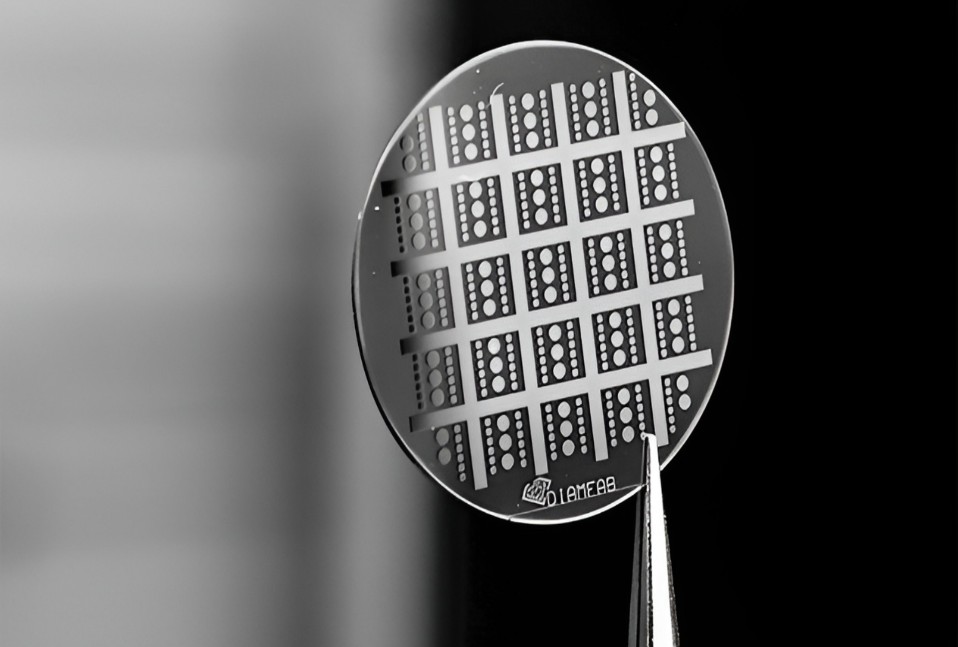
Figure 1. Next-Generation Chip.
Vibrations Replace Conventional Quantum Memory
Unlike traditional quantum memory, which relies on electromagnetic states, the new approach stores information through tiny mechanical vibrations. Similar to the strings of a musical instrument producing different notes, each mechanical resonator supports multiple vibrational modes that can independently encode quantum information.
Despite measuring only a few millimeters in size, these microscopic resonators can store multiple quantum states simultaneously while maintaining them for longer periods. Their compact design also offers greater storage density than conventional electromagnetic memory, making them an attractive solution for future large-scale quantum computers. Figure 1 shows Next-Generation Chip.
A Classical Computing Concept for Quantum Systems
One of the most significant innovations of the architecture is the clear separation between processing and memory. Much like a traditional computer uses a central processing unit (CPU) and separate memory, the ETH Zurich system assigns distinct roles to its superconducting qubits and mechanical resonators.
This design contrasts with many existing quantum computers, where processing and memory functions are closely integrated, creating challenges for scaling up to larger systems. By separating these components, the new architecture offers greater flexibility and a clearer path toward practical quantum computing.
Demonstrating Real Quantum Computation
To validate the new platform, the research team successfully integrated superconducting qubits with mechanical resonators and demonstrated reliable storage, retrieval, and manipulation of quantum information.
The researchers further tested the system by implementing two fundamental quantum algorithms—the Quantum Fourier Transform and a period-finding algorithm. Both require precise coordination of multiple quantum states and are considered essential building blocks for many advanced quantum computing applications.
Successful execution of these algorithms confirmed that the hybrid architecture can perform the key operations needed for general-purpose quantum information processing.
A Step Toward Scalable Quantum Computers
One of the biggest obstacles facing quantum computing is the challenge of building machines capable of supporting millions of qubits without excessive size, complexity, or energy consumption. Conventional electromagnetic memory occupies significant space, limiting the practical expansion of quantum processors.
Mechanical resonators offer a promising alternative by delivering higher storage capacity, longer coherence times, and a much smaller physical footprint. Their compact design could make future quantum computers more scalable while improving overall system stability and efficiency.
Although the technology remains in the early stages of development, the ETH Zurich team's research represents an important milestone in the evolution of quantum computing [1]. By combining superconducting processors with vibration-based quantum memory, the new architecture provides a practical foundation for building larger, more reliable quantum systems capable of solving problems far beyond the reach of today's classical computers. As quantum technology continues to advance, the gentle vibrations of microscopic mechanical resonators may become the key to unlocking the next generation of powerful, scalable quantum machines.
Reference:
- https://bioengineer.org/computer-chip-uses-vibrations-for-memory-storage/
Cite this article:
Keerthana S (2026), Next-Generation Chip Harnesses Vibrations to Store Information, AnaTechMaz, pp.470
Recent Post
-

New Wireless Drone Swarm Stays Aloft Indefinitely
A new defense technology initiative is aiming to eliminate one of the biggest limitations facing small drones: ...
-

This Plastic Motor Could Change the Future of Engineering
For more than 100 years, electric motors have relied on magnetic fields to generate motion....
-
China Invests $210 Million in Diamond Semiconductor Technology
China has unveiled a $210 million initiative to establish its first...
-

New Aviation Software Engine Reduces Risk of Flight Plan Errors
Artificial intelligence is transforming industries worldwide, but aviation has remained one of the most....
-
Next-Generation Chip Harnesses Vibrations to Store Information
Researchers at ETH Zurich, led by quantum physicist Yiwen Chu, have unveiled a pioneering....
-

World’s Biggest Hybrid Solar Plant Stores Heat for Nighttime Power
China Three Gorges Corporation (CTG) has begun commercial trial operations at the Hami Hybrid Solar Power...
-

Tiny Chemical Trick Could Revolutionize Computer Chips
A new advance in plasma chemistry could help enable the next generation of smaller, faster, and more powerful....
-

Cyber Negotiator Sentenced After Colluding with Ransomware Hackers
Angelo Martino, a ransomware negotiator trusted to assist victims....