

Astronomers May Have Spotted Signs of the Most Massive Stars Ever Observed
The distant universe may be filled with gigantic stars weighing between 1,000 and 10,000 times the mass of our sun—an astonishing possibility that could help explain how some of the universe’s most enormous black holes first formed.

Figure 1. Massive Stars.
Thanks to the James Webb Space Telescope (JWST), astronomers are now able to study early galaxies with unprecedented clarity. Several of these ancient galaxies show unusual chemical fingerprints that hint at the existence of extraordinary supermassive stars far larger than anything previously confirmed—potentially reaching up to 10,000 solar masses. Figure 1 shows Massive Stars.
Such colossal stars defy what we understand about stellar limits. In the modern universe, stars appear capped at around 120 solar masses, and current galaxy evolution models rely on that limit. “All of our models assume stars cannot exceed about 120 solar masses,” says Devesh Nandal of the Harvard-Smithsonian Center for Astrophysics [1]. “There have certainly been theoretical proposals suggesting they could be larger, but until now, no observations have offered convincing evidence.”
Reference:
- https://www.newscientist.com/article/2505306-astronomers-may-have-glimpsed-evidence-of-the-biggest-stars-ever-seen/
Cite this article:
Keerthana S (2025), Astronomers May Have Spotted Signs of the Most Massive Stars Ever Observed , AnaTechMaz, pp.657
Recent Post
-

Unprecedented Gamma-Ray Explosion Lasted 7 Hours, Baffles Scientists
Building on earlier findings, a research team led by Jonathan Carney, a...
-
Scientists Stunned as Neutron Star Brightens 100-Fold Overnight
A research team has investigated long-term variations in the X-ray emissions of the neutron star NGC 7793...
-

Stunning Discovery: Exoplanet Caught Orbiting Two Suns Like ‘Tatooine
The Northwestern team uncovered the new exoplanet by revisiting data...
-
Titan’s “Hidden Ocean” Might Be a Myth—And That Could Rewrite What We Know
Launched in 1997, Cassini spent nearly 20 years studying Saturn and its..
-

What Appeared to Be a Planet Turned Out to Be a Violent Cosmic Collision
For many years, astronomers have questioned the true nature of a bright...
-

Dark Energy in Flux: Insights from Supercomputer Simulations
Emerging observations are starting to question the traditional view of dark energy as a constant...
-

Astronomers Stunned by Discovery of a Completely New Exoplanet with a Strange Atmosphere
The newly discovered planet, PSR J2322-2650b, orbits a rapidly rotating...
-
Webb Telescope Discovers the Most Distant Supernova in the Universe
The key finding came from focused observations made with JWST’s Near...
-

Astronomers Crack the Long-Standing Mystery of Betelgeuse
Using the Hubble Space Telescope alongside ground-based instruments at the Fred Lawrence Whipple...

NASA Captures a “Dead” Star Reawakening in Dazzling X-Ray Detail
In intermediate polar systems, gas spirals inward through a rotating...
-
Scientists Monitored a Giant Solar Region for 94 Days — Here’s What They Found
Active regions on the sun are shaped by intense, twisted magnetic fields...
-
Astronomers May Have Spotted Signs of the Most Massive Stars Ever Observed
The distant universe may be filled with gigantic stars weighing..
-
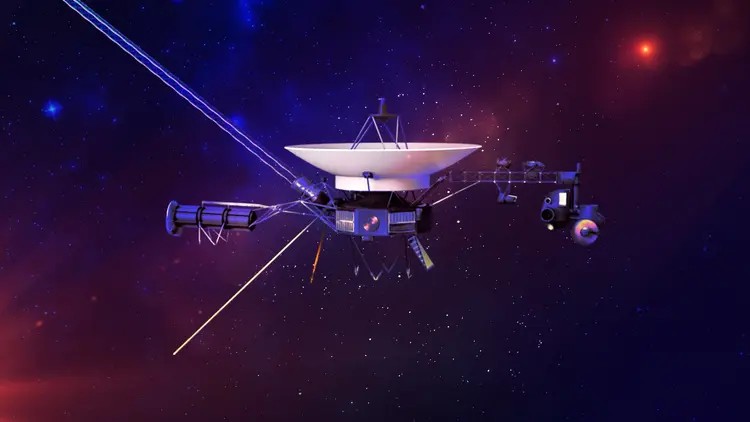
World’s Farthest Spacecraft Voyager 1 Nears Distance of One Light-Day from Earth
NASA’s Voyager 1 and Voyager 2 remain the longest-operating...
-

US Space Solar Company Sets New World Record for Transmitting Power Wirelessly from Space
Space-based solar power company Star Catcher Industries has achieved...
-

US Company Developing ‘Space Gun’ Capable of Launching Satellites
Longshot, an aerospace startup founded in 2021, is building a ground..