

Quantum Computer Reveals New Insights into the Potential Collapse of the Universe
Quantum field theory proposes that the fundamental structure of the universe could shift, transforming the cosmos as we know it. A new quantum machine may help explore this mysterious phenomenon while also advancing quantum computing technology.
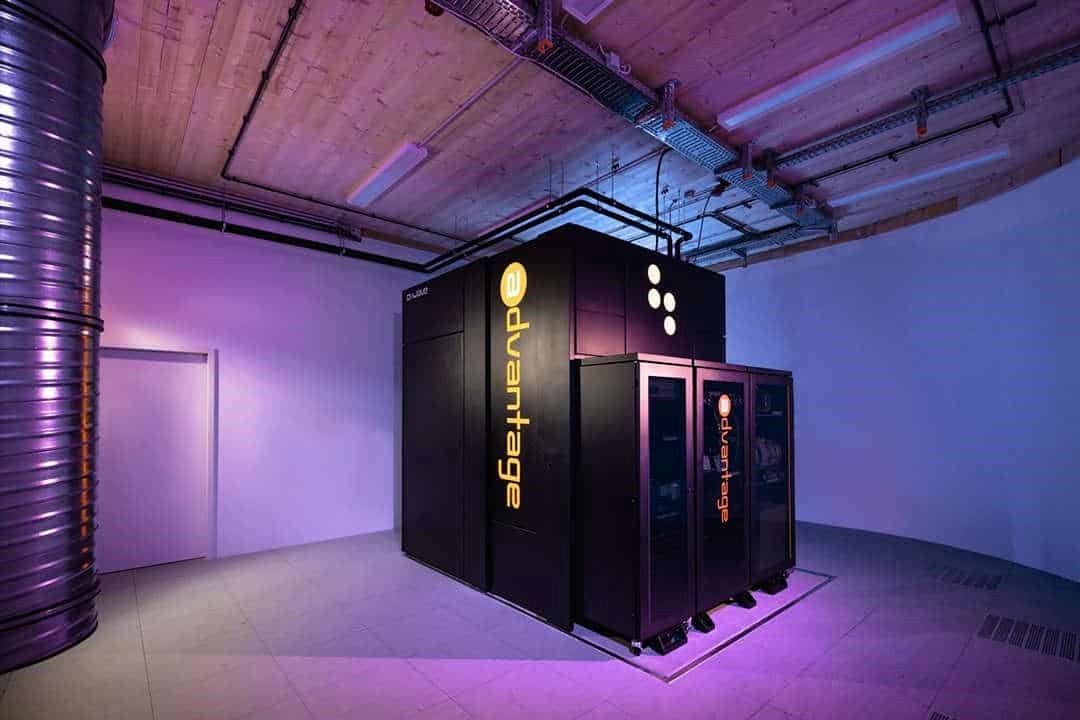
Figure 1. D-Wave quantum annealer in the JUNIQ building at Forschungszentrum Jülich.
The idea originates from predictions about the behavior of the Higgs field, which is associated with the Higgs boson—a concept Cosmos first explored nearly a decade ago in an article worth revisiting [1]. Figure 1 shows D-Wave quantum annealer in the JUNIQ building at Forschungszentrum Jülich.
In simple terms, the Higgs field, like an electric or magnetic field, has a “potential” that determines its strength. This potential can be visualized as a cart on a rollercoaster: the higher the cart is on the track, the more potential energy it holds.
TThe Higgs potential dictates whether the universe is in a true or false vacuum state. A true vacuum is the lowest-energy state, meaning it is stable—similar to a cart resting on a low, flat section of the track.
A false vacuum, on the other hand, is like a cart precariously stuck on a steep section of the track. A small disturbance could send it plummeting to a lower energy state, potentially altering the fundamental nature of the universe.
If the universe exists in a false vacuum, it is considered "metastable." In this state, the metaphorical rollercoaster cart is neither tumbling down nor resting securely in a true vacuum—it remains precariously balanced, stable for now but not permanently so.
If the universe exists in a false vacuum, it is considered "metastable," meaning it is temporarily stable but not truly secure. In this analogy, the rollercoaster cart is neither falling nor settled in a true vacuum state—it remains in a delicate balance, poised for potential change.
Possible Consequences
Measurements of the Higgs boson's mass suggest that the universe exists in a metastable state, poised for a potential shift.
A high-energy event could trigger "false vacuum decay," causing a small region of the universe to transition to a true vacuum state. This bubble would then expand at the speed of light, consuming everything in its path. Alternatively, quantum mechanics suggests that a particle could spontaneously tunnel into a true vacuum state, setting off the same catastrophic process.
“We’re talking about a process by which the universe would completely change its structure,” says Zlatko Papic, a professor at the University of Leeds, UK. “The fundamental constants could instantaneously change, and the world as we know it would collapse like a house of cards.”
"What we truly need are controlled experiments to observe this process and determine its timescales," says Papic.
A Powerful Quantum Computer Is All It Takes
The research team used a specialized machine to simulate the behavior of bubbles in a false vacuum—similar to how liquid bubbles form within water vapor.
The machine, known as a quantum annealer, is a type of quantum computer that harnesses quantum fluctuations to optimize processes by finding the minimum energy state within a given system.
“By leveraging the capabilities of a large quantum annealer, our team has opened the door to studying non-equilibrium quantum systems and phase transitions that are otherwise difficult to explore with traditional computing methods,” says first author Jaka Vodeb from the Forschungszentrum Jülich research institute in Germany.
The team configured 5,564 qubits to represent a false vacuum state and then “triggered” a decay into a true vacuum. While the simulation was conducted in a one-dimensional model, the researchers believe they can extend it to three dimensions using the same quantum annealer.
“It’s exciting to have these new tools that could effectively serve as a table-top ‘laboratory’ to understand the fundamental dynamical processes in the Universe,” says Papic.
Beyond addressing some of the universe’s most fundamental questions, the researchers believe their findings will also advance quantum computing [2]. Understanding how bubbles interact in a false vacuum could lead to better error management in quantum systems and improvements in solving complex calculations.
“These breakthroughs not only push the boundaries of scientific knowledge but also pave the way for future technologies that could revolutionize fields such as cryptography, materials science, and energy-efficient computing,” says Vodeb.
Reference:
- https://cosmosmagazine.com/science/physics/quantum-computer-universe-collapse/
- https://thequantuminsider.com/2025/02/04/quantum-annealer-unveils-clues-about-the-universes-fundamental-structure/
Cite this article:
Keerthana S (2025),Quantum Computer Reveals New Insights into the Potential Collapse of the Universe, AnaTechMaz, pp. 190
Recent Post
-

The Role of Diamonds in Advancing Electronics and Quantum Technology
Diamond, celebrated for its unmatched hardness and clarity, is emerging.....
-
MIT's Fluxonium Qubits Set New Standard for Quantum Precision
Quantum computing harnesses the principles of quantum mechanics to solve complex...
-

Physicists Uncover Hidden Quantum Forces That Could Revolutionize Your Devices
In today’s rapidly evolving digital landscape, the demand for increased storage, efficiency...
-
Exploring the Interaction of Light and Matter at the Nanoscale for Quantum Science
The succinct trio of terms masks the vast scope of science investigated by Randall.....
-

Dual-Code Error Correction Makes Quantum Computers Smarter
Classical computers are equipped with methods to detect and correct errors by comparing...
-
Quantum Squeezing Enables Ultra-Fast Gas Sensors
The research on enhancing gas detection speed using frequency comb lasers is a...
-

How Hydrogen Ions Are Transforming Quantum Technology
Has introduced a groundbreaking method for controlling the electronic properties.....
-

Quantum Computing's Greatest Challenge Overcome with Self-Assembling Qubits
Qubits are the fundamental units of information in quantum technology, but a ...
-

New Experimental System Brings Quantum Technology Within Reach of Students
Quantum physics is experiencing a second revolution, set to propel advancements.....
-
Quantum Computer Reveals New Insights into the Potential Collapse of the Universe
Quantum field theory proposes that the fundamental structure of the universe could shift...
-
Psiquantum Aims to Construct the World's Largest Quantum Computer By 2027
PsiQuantum is investing AU$1 billion to develop a photonic quantum computer with one...
-

Scientists Achieve Historic Milestone in Linking Quantum Processors for Scalable Supercomputers
Scientists at Oxford have made a significant advancement in quantum computing...
-
Forschungszentrum Jülich Acquires D-Wave Quantum Computer, First HPC Center to Own System
Forschungszentrum Jülich (FZJ) becomes the first high-performance computing.....
-

Germany Allocates €20 Million for Quantum Repeater Technology to Transform Future Networks
Amid growing concerns over cyber sabotage, espionage, and hybrid warfare.....
-

Physicists Unveil the Hidden Quantum Landscape of Electrons
A groundbreaking method has unveiled the complete quantum identity of......