

The Security Risks Lurking Behind Modern Browser Extensions
Browser extensions have become an essential part of modern web browsing. From grammar checkers and password managers to AI writing assistants and productivity tools, millions of users rely on them every day. Yet beneath their convenience lies a growing cybersecurity concern that many organizations have failed to fully address.
According to LayerX's Enterprise Browser Extension Security Report 2026, browser extensions have become nearly universal across corporate environments. Analysis of more than one million enterprise devices found that 99% of employees use at least one browser extension, while a significant number operate with ten or more extensions installed simultaneously.
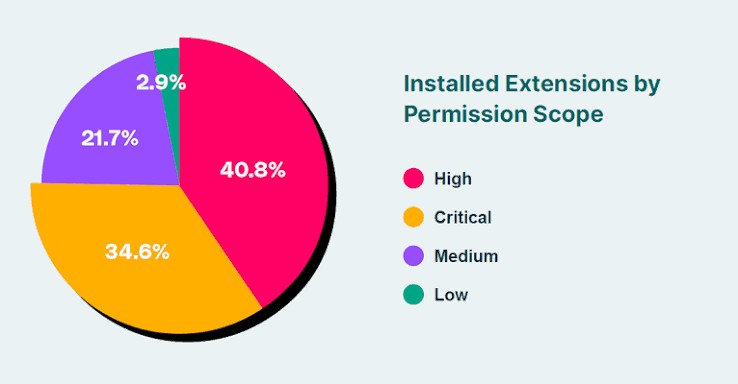
Figure 1. Modern Browser Extensions.
The widespread adoption of extensions has created a largely unmanaged attack surface. Many organizations lack visibility into which extensions employees are using, what permissions those tools possess, and how they interact with sensitive corporate data. Unlike traditional software, browser extensions often operate quietly in the background with minimal oversight from security teams. Figure 1 shows modern browser extensions.
The report found that nearly three-quarters of all browser extensions request high or critical permission levels. These permissions can allow extensions to access browser cookies, monitor user activity, inject code into web pages, manage browser tabs, and interact with sensitive information flowing through web applications.
AI Extensions Introduce Elevated Risks
The rapid adoption of artificial intelligence tools has accelerated the emergence of AI-powered browser extensions, including writing assistants, summarization tools, productivity copilots, meeting assistants, and content generators. While these tools promise significant productivity gains, they also introduce new security concerns.
LayerX found that approximately one in six enterprise users already has at least one AI extension installed, with adoption continuing to grow. More importantly, AI extensions appear to carry substantially greater security risks than traditional browser add-ons.
Compared to the average browser extension, AI-powered extensions are significantly more likely to contain known security vulnerabilities. They are also far more likely to request access to browser cookies, scripting capabilities, and tab management functions—permissions that could potentially expose authentication tokens, browsing activity, and sensitive corporate information.
Security researchers warn that when combined, these capabilities could provide malicious or compromised extensions with broad visibility into user behavior and access to critical business applications.
A Threat That Evolves After Installation
One of the report's most concerning findings involves permission changes that occur after installation. Users often evaluate an extension's permissions only once—during installation—assuming those permissions will remain unchanged.
However, LayerX found that AI extensions are considerably more likely to expand their privileges over time. In many cases, extensions receive updates that grant additional access to browser data, cookies, browsing history, or active web sessions without attracting significant user attention.
The research indicates that nearly two-thirds of users have at least one AI extension that modified its permissions during the past year. This suggests that extension risk is not limited to the initial installation process but continues to evolve throughout the software's lifecycle.
Limited Transparency and Weak Trust Signals
The report also highlights a lack of transparency within the browser extension ecosystem. Many AI extensions have relatively small user bases, making it difficult for organizations to assess their trustworthiness through community feedback or long-term reputation.
Equally concerning is the lack of privacy disclosures [1]. A large majority of extensions provide little or no information regarding how user data is collected, stored, processed, or shared. As a result, many employees unknowingly install tools that operate with extensive access to sensitive information while offering minimal transparency about their data-handling practices.
Security Teams Face a Growing Challenge
As AI-powered browser tools become increasingly integrated into daily workflows, organizations must balance productivity gains with emerging security risks. Experts recommend implementing extension governance policies, continuously monitoring installed extensions, restricting high-risk permissions, and educating employees about the potential dangers associated with third-party browser add-ons.
The findings serve as a reminder that browser extensions are no longer simple productivity tools. With deep access to browsers, web applications, and user data, they have become a significant cybersecurity consideration—particularly as AI-powered extensions continue to gain popularity across enterprise environments.
Reference:
- https://www.digitalinformationworld.com/2026/05/why-browser-extensions-especially-ai.html
Cite this article:
Keerthana S (2026), The Security Risks Lurking Behind Modern Browser Extensions, AnaTechMaz, pp.195
Recent Post
-

OpenAI Adopts Power-First Approach in AI Data Center Strategy
OpenAI is addressing one of the fastest-growing bottlenecks...
-

AI Chatbots Surpass Human Teams in Medical Data Analysis
Quicker and more advanced data analysis has the potential to significantly improve...
-

Optimizing Hybrid Powertrains Using Real-Time Route Data
Among the most compelling aspects of the research is the emphasis on environmental...
-

Health Data and Digital Privacy in the Prison System
A new study is bringing overdue attention to how personal health information is managed ...

-

Arista Unveils Liquid-Cooled Pluggable Optic Module for AI Data Centers
Arista introduced the eXtra-dense Pluggable Optics (XPO)...
-

Old Servers Could Unlock a New Source of Rare Earths Through Data Mining
Retiring old server hardware from data centers may soon shift from...
-

AI Data Centers Could Raise Nearby Temperatures by Up to 9.1°C
AI-powered data centres generate such intense heat that they can raise nearby land surface temperatures...
-

Smart Batteries Use Sensor Data to Boost Safety and Reliability
Researchers have introduced a groundbreaking “Talkative Battery” that combines advanced safety....
-

Inside Amazon’s Push for Ultra-Efficient Data Center Water Use
As scrutiny intensifies over the environmental impact of artificial intelligence and cloud computing,....
-

Texas Leak Reveals Data of 3 million Hunters and Anglers
The Texas Parks and Wildlife Department (TPWD) has revealed a cybersecurity incident involving....
-

Meta Alerts Thousands of Instagram Users to AI-Driven Account Takeovers
Meta has notified approximately 20,000 Instagram users that their ...
-

Kodak Faces Data Breach Fallout After ShinyHunters Hack Claims
Kodak has confirmed a cybersecurity incident after the notorious ShinyHunters cybercrime...
-

Healthcare Firm iRhythm Confirms Stolen Data in Cyberattack
Digital healthcare company iRhythm has disclosed a cybersecurity incident that resulted in the theft of ....
-
The Security Risks Lurking Behind Modern Browser Extensions
Browser extensions have become an essential part of modern web browsing. From grammar checkers and....