

China’s “Salt and Pressure” Cooling Method Can Reach Sub-Zero Temperatures in Seconds for Data Centers
A newly proposed liquid-cooling technique could absorb heat almost instantly, offering a potential solution for the extreme thermal demands of AI data centers. Researchers in China report developing a method that can chill a liquid cooling medium to sub-zero temperatures in under 30 seconds. Rather than relying on a new refrigerant, the approach uses a pressure-driven chemical process based on how certain salts behave in water. According to The South China Morning Post, the system exploits the unusual solubility of ammonium thiocyanate when combined with water and pressure.

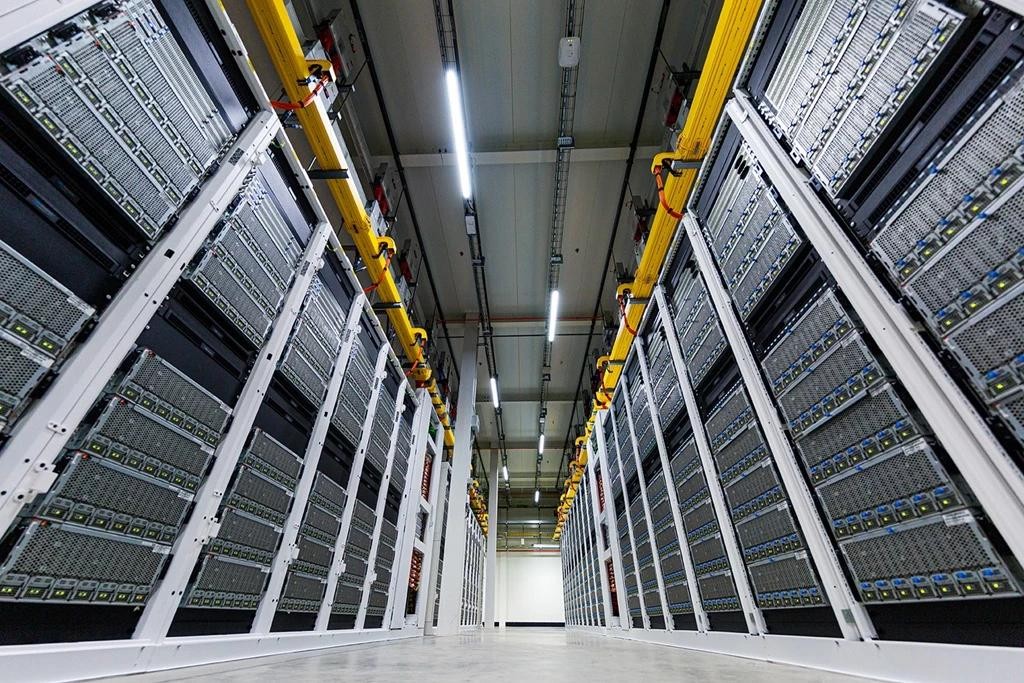
Figure 1. Data Centers.
Under high pressure, large amounts of the salt dissolve into water, forming a highly concentrated solution—similar to how a sponge absorbs liquid when squeezed. When the pressure is suddenly released, the salt reorganizes into a more stable state, a process that rapidly absorbs heat from its surroundings. The result is a sharp temperature drop of tens of degrees within seconds, driven by an enhanced form of endothermic dissolution. Figure 1 shows Data Centers.
This mechanism differs from conventional data-center cooling methods such as fans, air conditioning, chilled-water loops, or immersion cooling, all of which require continuous energy to move heat elsewhere. Instead, the new process stores chemical potential in the pressurized salt solution and releases cooling on demand, delivering very high cooling power for short periods.
Such rapid-response cooling could be particularly valuable for AI data centers, which rely on dense clusters of GPUs and other power-hungry hardware [1]. These systems generate intense, localized heat and are prone to sudden thermal spikes during computationally demanding tasks like model training, making heat management especially challenging and costly.
In some facilities, cooling accounts for 30% to 50% of total power consumption. The salt-based approach could help manage brief but extreme heat surges, reducing peak cooling loads and associated costs. Rather than replacing existing systems, it could function as a thermal buffer—similar to a cooling capacitor—smoothing out sudden temperature shocks.
However, significant hurdles remain. The salt solution must be re-pressurized after use, introducing additional energy costs. Long-term issues such as corrosion, chemical stability, and system durability have yet to be resolved, and it remains unclear whether the technology can be scaled economically for real-world data centers.
References:
- https://interestingengineering.com/innovation/chinas-cooling-touch-sub-zero-in-seconds
Cite this article:
Keerthana S (2026), China’s “Salt and Pressure” Cooling Method Can Reach Sub-Zero Temperatures in Seconds for Data Centers, AnaTechMaz, pp.184
Recent Post
-

OpenAI Adopts Power-First Approach in AI Data Center Strategy
OpenAI is addressing one of the fastest-growing bottlenecks...
-

AI Chatbots Surpass Human Teams in Medical Data Analysis
Quicker and more advanced data analysis has the potential to significantly improve...
-

Optimizing Hybrid Powertrains Using Real-Time Route Data
Among the most compelling aspects of the research is the emphasis on environmental...
-

Health Data and Digital Privacy in the Prison System
A new study is bringing overdue attention to how personal health information is managed ...
-

Arista Unveils Liquid-Cooled Pluggable Optic Module for AI Data Centers
Arista introduced the eXtra-dense Pluggable Optics (XPO)...
-

Old Servers Could Unlock a New Source of Rare Earths Through Data Mining
Retiring old server hardware from data centers may soon shift from...
-

AI Data Centers Could Raise Nearby Temperatures by Up to 9.1°C
AI-powered data centres generate such intense heat that they can raise nearby land surface temperatures...
-

Smart Batteries Use Sensor Data to Boost Safety and Reliability
Researchers have introduced a groundbreaking “Talkative Battery” that combines advanced safety....
-
Inside Amazon’s Push for Ultra-Efficient Data Center Water Use
As scrutiny intensifies over the environmental impact of artificial intelligence and cloud computing,....
-

Texas Leak Reveals Data of 3 million Hunters and Anglers
The Texas Parks and Wildlife Department (TPWD) has revealed a cybersecurity incident involving....
-

Meta Alerts Thousands of Instagram Users to AI-Driven Account Takeovers
Meta has notified approximately 20,000 Instagram users that their ...
-

Kodak Faces Data Breach Fallout After ShinyHunters Hack Claims
Kodak has confirmed a cybersecurity incident after the notorious ShinyHunters cybercrime...
-

Healthcare Firm iRhythm Confirms Stolen Data in Cyberattack
Digital healthcare company iRhythm has disclosed a cybersecurity incident that resulted in the theft of ....
-
The Security Risks Lurking Behind Modern Browser Extensions
Browser extensions have become an essential part of modern web browsing. From grammar checkers and....