

Water’s Secret Unveiled – It Can Exist in Two Liquid States Simultaneously
The Extraordinary Properties of Water
Water is a truly remarkable substance, known for its ability to naturally exist as a solid, liquid, and gas simultaneously. For instance, ice can float on a pond, with liquid water beneath and water vapor forming clouds above. Another unique characteristic is that ice is less dense than liquid water, allowing it to float.
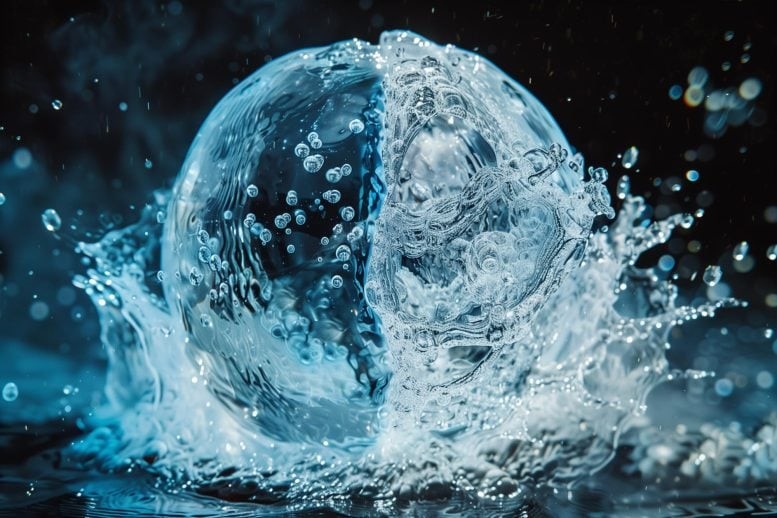
Figure 1. Water’s Hidden Duality – Two Liquid States at Once.
Now, researchers at the University of California San Diego have uncovered yet another fascinating property of water. Under extreme pressure and low temperatures, liquid water can separate into two distinct phases—one denser than the other. This groundbreaking discovery, published in Nature Physics, offers deeper insight into water’s intricate and unusual behavior. Figure 1 shows Water’s Hidden Duality – Two Liquid States at Once.
Molecular Modeling: A Cutting-Edge Approach
Francesco Paesani, a professor of chemistry and biochemistry at UC San Diego, leads a research team that blends chemistry, physics, and computer science to develop advanced models of molecular behavior. By leveraging machine learning and computational algorithms, his team creates highly accurate simulations that closely align with experimental data.
Unveiling Water’s Critical Point
Most liquids are homogeneous, meaning their molecules flow together seamlessly. Water generally follows this rule, but in 1992, scientists theorized that under specific conditions, it could reach a critical point where it would no longer behave as a uniform liquid.
Through advanced simulations, Paesani’s team pinpointed this critical point—occurring at an extremely low temperature (198 Kelvin or -103°F) and a high pressure (1,250 atmospheres). Under these conditions, water spontaneously separates into two distinct liquid phases: one dense and one less dense.
At this threshold, water undergoes dramatic fluctuations between its high- and low-density states. Below this pressure, it stabilizes in its low-density phase, while above it, it shifts entirely to the high-density phase. This unexpected molecular behavior challenges our understanding of water’s properties.
Advancing Computational Models
The initial 1992 simulation of water’s critical behavior was relatively crude. Since then, researchers have attempted to experimentally confirm the spontaneous separation of water into distinct liquid phases—but without success. However, advancements in computational modeling over the past three decades have enabled more detailed and precise simulations, particularly through the development of data-driven many-body potentials, a field in which Paesani’s group excels.
The Paesani group’s MB-pol (many-body potential) model is a groundbreaking approach that combines high-level quantum mechanical calculations with machine learning. Instead of calculating the energy of an entire system at once, MB-pol breaks it down into individual contributions, making simulations far more accurate. This method allows researchers to model water’s behavior across its entire phase diagram with unprecedented precision.
Understanding Water at the Quantum Level
Paesani explains MB-pol using an analogy: Imagine a person alone in a room. Their behavior changes when another person enters, and it shifts again with a third person. As more people enter, individual interactions evolve, but beyond a certain point, adding another person has little effect on the overall dynamic.
Similarly, in MB-pol simulations, quantum mechanical effects strongly influence water molecules at short ranges, just as people directly influence one another in small groups. However, as the system grows, these effects average out over the entire system, much like a crowded room where one additional person has minimal impact on the group’s overall behavior.
Supercomputers and the Future of Research
“Quantum mechanical simulations can be extremely expensive—you might only be able to calculate the energies of five or six water molecules,” Paesani explained. “Our method, using MB-pol and machine learning, allows us to run simulations for up to several microseconds. This is something computational molecular scientists have dreamed about for a long time.”
Synthetic Liquids and Future Possibilities
As technology advances, Paesani envisions a future where this research could inspire the development of synthetic liquids that exhibit liquid-liquid transitions similar to water—but under everyday conditions. These porous liquids, capable of shifting between low and high densities, could function like sponges, making them useful for applications such as pollutant capture and water desalination.
“The simulation took almost two years, so this is a really exciting accomplishment,” Paesani remarked. “I think our estimate is very realistic. Now it’s up to the experimental researchers to see whether our predictions are correct.”
The Challenge of Experimental Proof
Reproducing these extreme conditions in a laboratory remains a significant challenge. However, nanodroplet technology may provide a potential solution. By creating tiny water droplets with high internal pressure due to surface tension, researchers might be able to experimentally confirm this long-theorized phenomenon.
For now, this discovery represents the most precise prediction yet of a behavior scientists have suspected but never directly observed. When that confirmation finally comes, it could transform our understanding of water—and its role in the world around us.
Source: SciTECHDaily
Cite this article:
Priyadharshini S (2025),"Water’s Secret Unveiled – It Can Exist in Two Liquid States Simultaneously", AnaTechMaz, pp. 219
Recent Post
-

China's New Quantum Computer Outperforms Google's, Operating a Million Times Faster
A groundbreaking advancement in quantum computing has shaken the tech industry, as researchers...
-

Breakthrough in Photon Entanglement Could Lead to Smaller Quantum Computers
Quantum computing has faced challenges in efficiently...
-

IBM's Quantum Breakthrough: Europe's First System Two Arrives in Spain
IBM and the Basque Government will install Europe’s first IBM Quantum System Two at the...
-

world-first: US-Designed Photon Router to Connect Qubits in Quantum Networks
The device bridges the significant energy gap between.....
-

A Quantum Computer Has Successfully Solved a Real-World Problem for The Automotive Giant, Ford
D-Wave Quantum Inc., based in Palo Alto, California, claims to be the first company to offer ...
-

A Crucial Advancement for Quantum Computers Enabling Direct Processor Communication
Quantum computers must efficiently share information between processors to realize their...
-

The Quantum Spin Discovery That Could Revolutionize Computing
The University of California, Riverside, in collaboration...
-

Scientists Discover Hidden Quantum Tornadoes with Potential to Transform Electronics
Scientists have long known that electrons can form vortices in quantum materials. However,...
-
Water’s Secret Unveiled – It Can Exist in Two Liquid States Simultaneously
Water is a truly remarkable substance, known for its ability...
-
Scientists Uncover a Surprisingly Simple Formula for Quantum Entanglement
Quantum entanglement is a phenomenon where two particles become interconnected, ...
-

Physicists Observe a Quantum Phase Flip—And It's Even More Mind-Bending Than Expected
Phase transitions, such as water freezing into ice, are common in everyday life. ...
-

Spinning Electrons Unravel a Long-Standing Semiconductor Mystery
Their semiconductor emits circularly polarized light, ...
-

A Small Twist Ignites a Quantum Breakthrough in Superconductors
Scientists at the RIKEN Center for Emergent Matter Science (CEMS) and their collaborators...
-

Hofstadter’s Butterfly Finally Lands – A 50-Year-Old Quantum Puzzle Solved
A team of Princeton University scientists has successfully measured electron energy levels...
-

Scientists Unlock Breakthrough in Capturing Ultrafast Electron Motion in Real Time
Two doctoral students from Lienau’s Ultrafast Nano-Optics research group, Daniel Timmer ...