

QuTech's Breakthrough in Somersaulting Spin Qubits for Efficient Quantum Logic
Researchers at QuTech have made a breakthrough in the field of quantum computing by developing somersaulting spin qubits, potentially enabling efficient control of large semiconductor qubit arrays. Their findings were published in Nature Communications and Science.
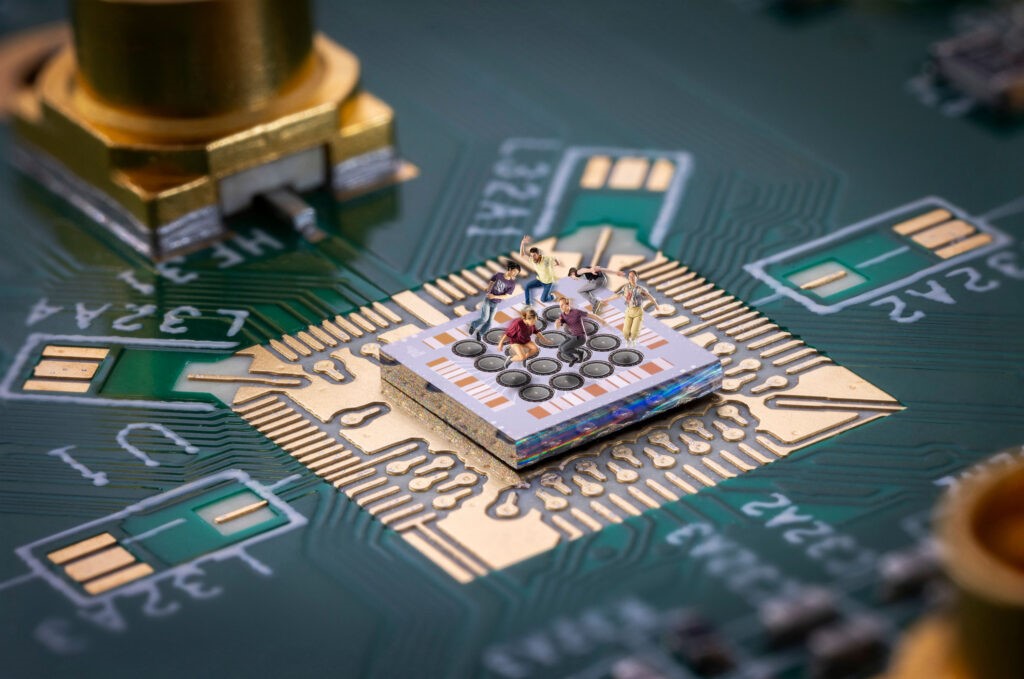
Figure 1. Spin Qubits [1]. (Credit: Studio Oostrum for QuTech.)
Figure 1 shows Spin qubits go trampolining to make quantum gates and couple to other spin qubits on the chip. In 1998, Loss and DiVincenzo introduced the concept of "quantum computation with quantum dots," proposing hopping spins as a foundation for qubit logic. However, experimental realization had remained elusive until now. Researchers at QuTech, a partnership between TU Delft and TNO, have demonstrated that the theoretical "hopping gates" are feasible with state-of-the-art performance.
Simplifying Control
Quantum dots-based qubits are globally researched for quantum computer development. Traditionally, a single electron's spin is used as a qubit, controlled by microwave signals and a strong magnetic field. However, the QuTech team has shown that baseband signals and small magnetic fields suffice for universal qubit control, potentially simplifying future quantum processors' control electronics.
From Hopping to Somersaulting Qubits
Spin control involves hopping from dot to dot and rotating the spin. Initially, Loss and DiVincenzo's proposal required a specific type of magnet, which proved challenging experimentally. The QuTech team instead utilized germanium, which inherently allows for spin rotations. [2] Their Nature Communications publication by Floor van Riggelen-Doelman and Corentin Déprez demonstrated germanium's potential as a platform for spin qubit hopping, showing initial indications of spin rotations.
Quantum dot arrays can be likened to a trampoline park, where electron spins hop between trampolines (quantum dots). Germanium's unique property induces a torque, making spins somersault during the hop, enabling effective qubit control.
Chien-An Wang, the first author of the Science paper, noted: "Germanium has the advantage of aligning spins along different directions in different quantum dots." This property allows for high-quality qubits. "We measured error rates less than a thousand for one-qubit gates and less than a hundred for two-qubit gates."
Somersaulting Qubits in a Trampoline Park
After establishing control over two spins in a four-quantum dot system, the team explored hopping through multiple quantum dots. This is akin to a person somersaulting over several trampolines. Co-author Valentin John explained: "For quantum computing, it is necessary to operate and couple large numbers of qubits with high precision."
Different trampolines cause varying torques when jumping, similar to the unique rotations from hopping spins between quantum dots. Thus, understanding this variability is crucial. Co-author Francesco Borsoi added: "We established control routines that enables to hop spins to any quantum dot in a 10-quantum dot array, which allows us to probe key qubit metrics in extended systems."
Team Effort
Principal investigator Menno Veldhorst expressed pride in the teamwork: "In a time span of a year, the observation of qubit rotations due to hopping became a tool that is used by the entire group. We believe it is critical to develop efficient control schemes for the operation of future quantum computers and this new approach is promising."
Source: Delft University of Technology
References:
- https://www.eurekalert.org/news-releases/1052478
- https://www.sciencedaily.com/releases/2024/07/240725154603.htm
Cite this article:
Hana M (2024), QuTech's Breakthrough in Somersaulting Spin Qubits for Efficient Quantum Logic, AnaTechMaz, pp. 147
Recent Post
-

Non-Toxic Quantum Dot Technology Powers Breakthrough in SWIR Image Sensors
In a groundbreaking development, researchers from ICFO and Qurv......
-

Efficient Generation and Assessment of Entanglement in Quantum Systems
Entanglement, a hallmark of quantum mechanics, is a unique correlation....
-
University of Ottawa Researchers Pioneer Revolutionary Quantum Circuit Evaluation Technique
A team of researchers from the University of Ottawa’s Nexus for Quantum Technologies Institute (NexQT) ...
-

Here's How We Can Enable the Next Major Advancement in Quantum Computing
Before revealing the first on-campus quantum computer in the US......
-

Controlling Quantum States with Spin-Polarized Currents
Electrons possess an intrinsic angular momentum called spin.....
-

Novel In Situ Luminescence Technique Enhances Quantum Dot Synthesis and Monitoring
Luminescence is the result of a process where an object absorbs light at...
-

Cooling Quantum Leap: EPFL’s Breakthrough Device Could Revolutionize Quantum Computing
In the realm of quantum computing, maintaining quantum bits (qubits)...
-
Advancing Quantum Computing: Simulating Quantum Materials with Quantum Annealers
Physicists have long pursued the concept of using quantum computers.....
-

Quantum Computers Are Like Kaleidoscopes, Illustrating Science and Technology in Fascinating Ways
Quantum computing is like Forrest Gump’s box of chocolates.....
-

Sound Science: Phononic Crystals' Impact on Quantum Computing
Researchers have created a genetic algorithm to design phononic......
-

A Quantum Algorithm Solves the Travelling Salesperson Problem Using Only 1 Qubit
Quantum physicists have created an algorithm that utilizes just one qubit to solve a problem that previously ...
-
QuTech's Breakthrough in Somersaulting Spin Qubits for Efficient Quantum Logic
Researchers at QuTech have made a breakthrough in the field of quantum.....
-

University of Bath Develops Specialty Optical Fibers for Future Quantum Computing Challenges
Physicists at the University of Bath in the UK have developed a new...
-

First Quantum Simulations Set New Standard for Biochemical Accuracy
Under the leadership of University of Melbourne theoretician.....
-

How UCSB Researchers Are Paving the Way for the Quantum Internet
The potential of quantum computing could be amplified by a quantum internet, and at the heart ...