

NASA’s X-59 Passes Major Test, Bringing Quiet Supersonic Flight One Step Closer
NASA’s X-59 has successfully completed electromagnetic interference (EMI) testing, confirming that its onboard systems operate without interference. The tests involved activating the aircraft’s avionics and sensors to ensure smooth functionality. NASA’s F-15D research aircraft was stationed near the X-59 at U.S. Air Force Plant 42 in Palmdale, California, where its radar, C-band transponder, and radios were tested at various distances to check for potential interference. These successful tests confirm that the X-59 can safely operate alongside other aircraft, bringing it closer to its first flight.This successful EMI testing indicates that the aircraft's integration is progressing and cleared a significant hurdle, moving it one step closer to its first flight.
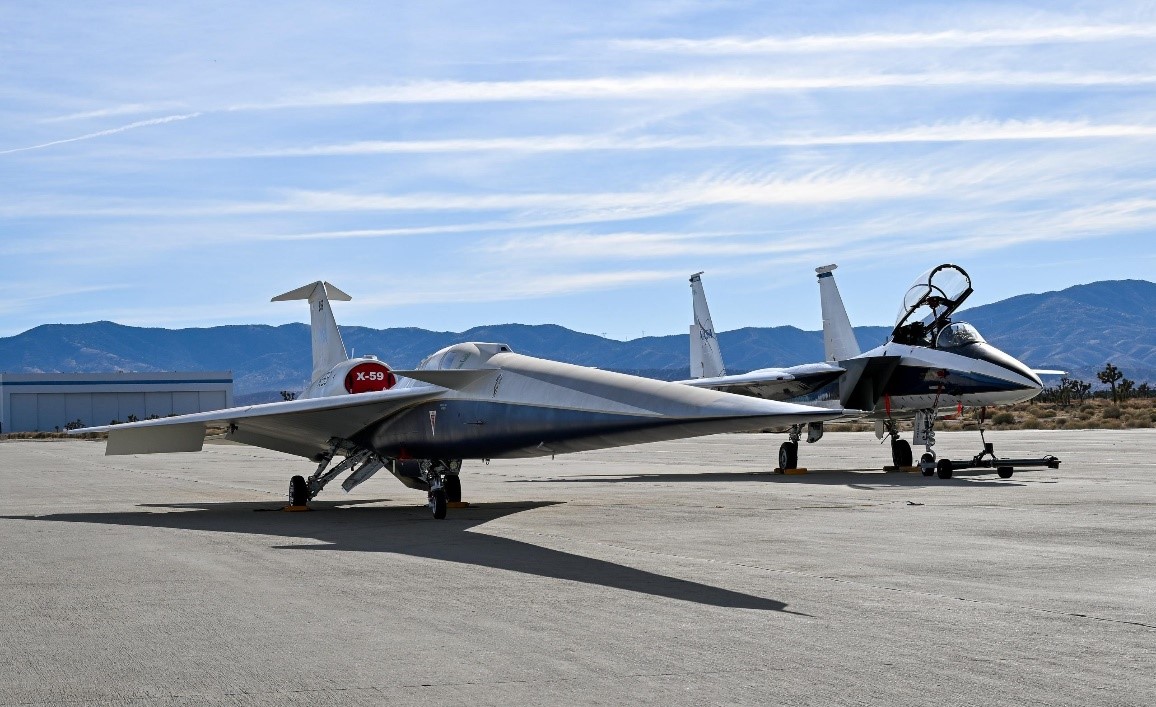
X-59’s Electromagnetic Testing Success
NASA's X-59, a quiet supersonic research aircraft, has successfully completed electromagnetic interference (EMI) testing, ensuring its systems can function safely without interference under various conditions.
"Reaching this phase shows that the aircraft integration is advancing," said Yohan Lin, NASA's X-59 avionics lead. "It's exciting to see the progress, knowing we've cleared a major hurdle that moves us closer to X-59's first flight."
Electromagnetic interference occurs when an electric or magnetic field disrupts an aircraft's operations, posing safety risks. This interference can originate from external sources or the aircraft's own equipment, potentially disrupting critical electronic systems—similar to how a nearby phone can cause static or crackling on a radio. Figure 1 shows Nasa’s X-59 Successfully Passes Key Test.
The successful completion of EMI testing indicates that the X-59's systems, including communications, navigation, and sensors, can operate harmoniously without causing disruptions [1]. This milestone is a significant step toward the aircraft's inaugural flight, bringing NASA closer to demonstrating quiet supersonic travel.
Ensuring Seamless Integration of Onboard Systems
The tests, carried out at Lockheed Martin Skunk Works’ facility in Palmdale, California, aimed to verify that the X-59's onboard systems — including radios, navigation equipment, and sensors — operated without interfering with each other or causing unexpected malfunctions. Engineers systematically activated each system one by one while closely monitoring the others for potential interference.“This process allowed us to identify whether any of the X-59’s systems were disrupting each other,” explained Lin. “It’s known as a source-victim test, where one system is turned on while the others are observed for signs of noise, glitches, faults, or errors.”
Progressing Toward the Quesst Mission's Objectives
The X-59 is designed to produce a soft thump instead of a loud sonic boom while traveling faster than the speed of sound. Serving as the centerpiece of NASA's Quesst mission, the aircraft aims to provide data that could help regulators reconsider existing bans on commercial supersonic flights over land. Currently, the X-59 is undergoing ground tests to validate its safety and performance, including a recently completed series of engine tests [2]. Following this, electromagnetic interference (EMI) tests were conducted to assess the compatibility of the aircraft’s internal electronic systems.
As part of the EMI tests, engineers evaluated the functionality of the X-59’s landing gear, ensuring that its extension and retraction did not interfere with other onboard systems. Additionally, they confirmed that the fuel shutoff switch operated without any electromagnetic disruption, ensuring the smooth operation of critical flight components.
Testing Compatibility with NASA’s F-15D
Electromagnetic compatibility tests were conducted to ensure the X-59’s systems would function properly near NASA’s F-15D aircraft. The two planes were positioned 47 feet apart, and then 500 feet apart, to simulate conditions for measuring shock waves from the X-59. The team powered up the X-59’s engine while activating the F-15D’s radar and radios. Data was transmitted to NASA’s Mobile Operations Facility for monitoring.
“We want to identify any electromagnetic interference or compatibility issues on the ground to reduce risks during flight,” said Lin.
With electromagnetic testing complete, the X-59 will proceed to aluminum bird tests, followed by taxi tests before its first flight.
Reference:
- https://scitechdaily.com/nasas-x-59-clears-critical-test-edging-closer-to-quiet-supersonic-flight/
- https://www.space.com/x-59-quiet-supersonic-jet-sci-fi-photos
Cite this article:
Keerthana S (2025),NASA’s X-59 Passes Major Test, Bringing Quiet Supersonic Flight One Step Closer , AnaTechMaz,pp.243
Recent Post
-

This Planet’s Orbit Made No Sense – Until Scientists Discovered a Hidden World
The hot Jupiter TOI-2818b exhibited unexpected timing variations, suggesting the presence...
-
Full Power, Mach Diamonds: NASA's X-59 Pushes Limits in High-Performance Engine Tests
NASA's X-59 has achieved another milestone with the successful completion of crucial ...
-
NASA’s X-59 Passes Major Test, Bringing Quiet Supersonic Flight One Step Closer
NASA’s X-59 has successfully completed electromagnetic interference (EMI) testing, confirming...
-

NASA and SpaceX Are Collaborating to Build the Most Advanced Space Station Yet – Orbiting the Moon
The Gateway space station will be humanity's first lunar-orbiting space station, playing a crucial ...
-

Scientists Finally Uncover Why Galaxy Clusters Remain Scorchingly Hot
XRISM Reveals How Galaxy Clusters Evolve — Violent Mergers Stir Turbulence, Keeping Hot ...
-

Hubble’s Breathtaking Space Illusion Unveils a Hidden Supernova Mystery
A mesmerizing new image from the Hubble Space Telescope captures a spiral galaxy...
-

Juno's Stunning Revelation: Io's Interior Defies Expectations
An artist's illustration depicts the internal structure of Jupiter's...
-

NASA's Innovative Space Workout Experiment Could Revolutionize Fitness Without a Treadmill
NASA’s SpaceX Crew-10 members participated in a crew equipment...
-

NASA’s EZIE Mission Aims to Track Earth’s Hidden Electric Currents to Forecast Space Storms
NASA’s upcoming Electrojet Zeeman Imaging Explorer (EZIE)...
-

Cosmic Chameleon: Astronomers Amazed by a Blazar’s Mysterious Light Display
Blazars are a type of active galaxy that emit intense jets...
-

What's the True Cause of the Northern Lights? NASA Is About to Discover
As part of SpaceX’s Transporter-13 mission, NASA’s EZIE CubeSats...
-

The Andromeda Enigma: Hubble Uncovers Unusual Galactic Activity
Picture the Milky Way and Andromeda as two colossal aircraft...
-

NASA's Upcoming Mission May Unravel the Mystery of the Solar System's Outer Edge
The heliosphere, a vast cosmic bubble shaped by the Sun, shields...
-

SpaceX Dragon Departs with NASA Crew-9 Astronauts for Return to Earth
At 1:05 a.m. EDT on Tuesday, March 18, NASA astronauts Nick...
-

The Sky Is Falling – Leaving Space Junk Trapped in Orbit
Greenhouse gas emissions are not only warming Earth but also altering near-...