

Full Power, Mach Diamonds: NASA's X-59 Pushes Limits in High-Performance Engine Tests
NASA's X-59 has achieved another milestone with the successful completion of crucial engine tests. The trials validated that its F414-GE-100 engine, derived from the F/A-18 Super Hornet, delivers optimal performance at full power.
Designed with a distinctive top-mounted engine and an elongated nose, the X-59 aims to reduce sonic booms to a gentle "thump." As NASA moves closer to the aircraft's first flight, further tests will be conducted to ensure its safe and efficient operation.
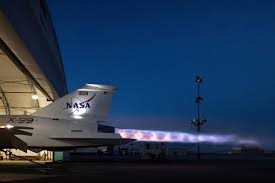
Engine Tests Achieve a Significant Milestone
NASA's X-59 quiet supersonic research aircraft has reached a major milestone, successfully completing a series of engine performance tests. In preparation for its first flight this year, NASA and Lockheed Martin conducted engine run tests in January, evaluating the performance of the F414-GE-100 engine and its integrated systems [1]. The tests confirmed smooth airflow, no structural issues, and effective cooling, meeting performance expectations at Lockheed Martin's Skunk Works facility in Palmdale, California. Figure 1 NASA's X-59.
Pushing Boundaries: High-Power Performance Testing
The tests began by evaluating the aircraft's hydraulics, electrical, and environmental control systems while the engine operated at idle. The team then conducted throttle checks, gradually increasing engine power to its maximum and engaging the afterburner — a component that provides additional thrust.
In a third test, known as throttle snaps, the team rapidly adjusted the throttle back and forth to ensure the engine could respond instantly. Capable of producing up to 22,000 pounds of thrust, the engine is designed to propel the X-59 to a cruising speed of Mach 1.4 (925 miles per hour) at an altitude of around 55,000 feet.
To minimize noise impact on the ground, the X-59’s engine, similar to those used in the U.S. Navy’s F-18 Super Hornet, is strategically mounted on top of the aircraft. Combined with its distinctive 38-foot-long nose, these design elements aim to transform the disruptive sonic boom into a subtle “thump,” comparable to the sound of a car door closing nearby.
What Lies Ahead Before Takeoff?
Several critical tests remain before the X-59 takes its first flight. Engineers will perform electromagnetic interference assessments to ensure the aircraft's systems are not affected by external electronic signals [2]. Additionally, they will conduct "aluminum bird" testing, simulating both normal and failure scenarios by feeding data into the aircraft to evaluate its response.
The team will also carry out a series of taxi tests, along with final system checks and preparations, to confirm the X-59 is flight-ready.
The X-59 serves as the centerpiece of NASA's Quesst mission, which focuses on addressing one of the major obstacles in commercial supersonic travel — minimizing the loud sonic boom to a softer, less disruptive "thump," making supersonic flights over land more practical.
Reference:
- https://www.nasa.gov/aeronautics/nasas-x-59-turns-up-power-throttles-through-engine-tests/
- https://scitechdaily.com/full-throttle-mach-diamonds-nasas-x-59-turns-up-power-soars-through-engine-tests/
Cite this article:
Keerthana S (2025),Full Power, Mach Diamonds: NASA's X-59 Pushes Limits in High-Performance Engine Tests , AnaTechMaz,pp.242
Recent Post
-

This Planet’s Orbit Made No Sense – Until Scientists Discovered a Hidden World
The hot Jupiter TOI-2818b exhibited unexpected timing variations, suggesting the presence...
-
Full Power, Mach Diamonds: NASA's X-59 Pushes Limits in High-Performance Engine Tests
NASA's X-59 has achieved another milestone with the successful completion of crucial ...
-
NASA’s X-59 Passes Major Test, Bringing Quiet Supersonic Flight One Step Closer
NASA’s X-59 has successfully completed electromagnetic interference (EMI) testing, confirming...
-

NASA and SpaceX Are Collaborating to Build the Most Advanced Space Station Yet – Orbiting the Moon
The Gateway space station will be humanity's first lunar-orbiting space station, playing a crucial ...
-

Scientists Finally Uncover Why Galaxy Clusters Remain Scorchingly Hot
XRISM Reveals How Galaxy Clusters Evolve — Violent Mergers Stir Turbulence, Keeping Hot ...
-

Hubble’s Breathtaking Space Illusion Unveils a Hidden Supernova Mystery
A mesmerizing new image from the Hubble Space Telescope captures a spiral galaxy...
-

Juno's Stunning Revelation: Io's Interior Defies Expectations
An artist's illustration depicts the internal structure of Jupiter's...
-
NASA's Innovative Space Workout Experiment Could Revolutionize Fitness Without a Treadmill
NASA’s SpaceX Crew-10 members participated in a crew equipment...
-

NASA’s EZIE Mission Aims to Track Earth’s Hidden Electric Currents to Forecast Space Storms
NASA’s upcoming Electrojet Zeeman Imaging Explorer (EZIE)...
-

Cosmic Chameleon: Astronomers Amazed by a Blazar’s Mysterious Light Display
Blazars are a type of active galaxy that emit intense jets...
-

What's the True Cause of the Northern Lights? NASA Is About to Discover
As part of SpaceX’s Transporter-13 mission, NASA’s EZIE CubeSats...
-

The Andromeda Enigma: Hubble Uncovers Unusual Galactic Activity
Picture the Milky Way and Andromeda as two colossal aircraft...
-

NASA's Upcoming Mission May Unravel the Mystery of the Solar System's Outer Edge
The heliosphere, a vast cosmic bubble shaped by the Sun, shields...
-

SpaceX Dragon Departs with NASA Crew-9 Astronauts for Return to Earth
At 1:05 a.m. EDT on Tuesday, March 18, NASA astronauts Nick...
-

The Sky Is Falling – Leaving Space Junk Trapped in Orbit
Greenhouse gas emissions are not only warming Earth but also altering near-...