

NASA's Innovative Space Workout Experiment Could Revolutionize Fitness Without a Treadmill
NASA’s SpaceX Crew-10 members participated in a crew equipment interface test (CEIT) on February 17, 2025, at SpaceX’s new Dragon processing facility at Kennedy Space Center in Florida. The crew includes Roscosmos cosmonaut Kirill Peskov (mission specialist), NASA astronauts Nichole Ayers (pilot) and Anne McClain (commander), and JAXA astronaut Takuya Onishi (mission specialist). The CEIT helps familiarize the crew with the Dragon spacecraft's interior, preparing them for their upcoming four-month mission to the International Space Station.
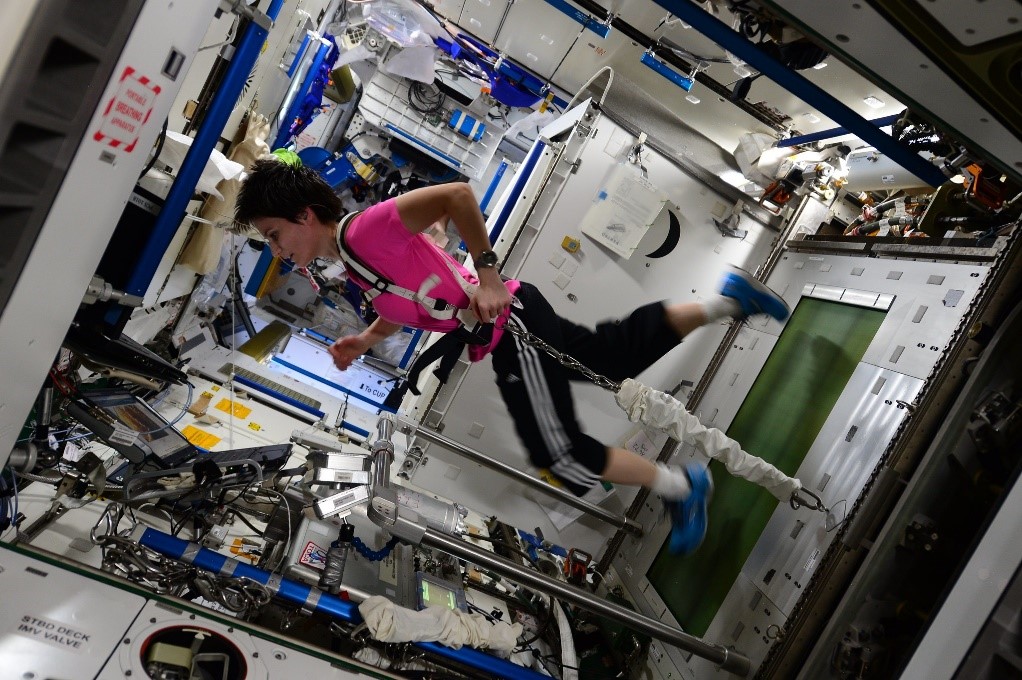
Figure 1. Astronaut Exercise – NASA.
NASA’s SpaceX Crew-10 to Trial Compact Exercise Methods for Future Deep-Space Missions
The Zero T2 study aims to explore alternative workout methods by eliminating treadmills, testing if astronauts can maintain strength without them. In addition to fitness experiments, the crew will engage in medical studies, examining vision changes and genetic factors influencing health in space. The findings will offer valuable insights for sustaining human health during future missions to the Moon and Mars. Figure 1 shows Astronaut Exercise – NASA.
Astronauts Test New Workout and Health Strategies for Future Space Missions
NASA’s SpaceX Crew-10 mission, scheduled to launch on March 12, will carry out exercise and medical research aimed at helping astronauts stay healthy during long-duration space missions. Some crew members will participate in studies focused on preserving physical health in space.
Aboard the International Space Station (ISS), astronauts utilize a dedicated training area equipped with a weight-lifting system, a stationary bike, and a specialized treadmill known as T2. The station's spacious design accommodates large exercise equipment, allowing astronauts to maintain their strength and overall well-being both during their mission and upon returning to Earth.
Astronauts on the International Space Station follow a rigorous two-hour daily exercise routine to maintain their physical health in microgravity. Using specialized equipment like treadmills, stationary bikes, and weightlifting machines, they engage in activities such as running, cycling, and strength training. These fitness regimens are crucial for preserving muscle mass, bone density, and overall well-being during their mission in space.
Preparing for deep-space missions, NASA is exploring compact workout solutions as large exercise equipment like treadmills may not fit aboard future spacecraft. Researchers are testing treadmill-free exercise regimens to understand their impact on muscle strength, bone health, and motor function, ensuring astronauts stay fit during long spaceflights.
Exploring Treadmill-Free Exercise for Deep-Space Missions
As part of the Zero T2 study, expedition crews are divided into three groups with different workout routines. One group uses all available exercise equipment, another skips the treadmill, and the third relies solely on a new, compact workout device [1]. NASA compares health data from before, during, and after the mission to assess the impact of treadmill-free workouts on fitness, muscle strength, and recovery.
The Zero T2 study aims to help researchers understand how treadmill-free workouts impact astronaut health, providing insights for developing effective exercise protocols for future deep-space missions. The findings could also contribute to improving exercise equipment for managing bone, muscle, and cardiovascular health on Earth.
In addition to the Zero T2 study, some NASA crew members will participate in other research supported by the agency’s Human Research Program. This involves undergoing medical exams, providing biological samples, and documenting spaceflight-related injuries to address key health risks associated with human spaceflight.
“Astronauts voluntarily choose which studies to participate in based on their interests,” said Cherie Oubre, a NASA scientist at Johnson Space Center, who oversees human research conducted aboard the space station.
The CIPHER (Complement of Integrated Protocols for Human Exploration Research) experiment aims to understand how different systems in the human body adapt to long-duration spaceflight. Crew members will undergo vision tests, cognitive assessments, and MRI scans to help researchers gain a comprehensive view of spaceflight’s impact on the body.
“The CIPHER study tracks changes in the eyes, bones, heart, muscles, immune system, and more,” explained Cherie Oubre, a NASA scientist. “This research will provide critical insights for future missions to the Moon, Mars, and beyond.”
Crew members will also participate in Spaceflight Standard Measures, a core set of tests tracking how the body and mind adjust to space travel over time. Additionally, they may contribute biological samples for the Omics Archive study, which analyzes molecular-level changes caused by prolonged spaceflight.
Another study will test treatments for spaceflight-associated neuro-ocular syndrome (SANS), a condition that causes swelling at the back of the eye and potential vision changes. Scientists suspect fluid shifts in microgravity or genetic differences in processing B vitamins may contribute to the condition. Crew members will test whether B vitamin supplements or thigh cuffs, designed to keep fluids in the lower body, can reduce or prevent SANS symptoms.
After returning to Earth, crew members will complete surveys documenting any injuries, such as bruises or scrapes, caused by landing. Combined with sensor data from the spacecraft, this information will help NASA improve vehicle design for future missions.
Long-Term Research to Support Future Space Missions
Crew members began participating in these studies about a year before their mission, providing baseline health data and familiarizing themselves with the research [2]. Data collection will continue for up to two years after their return to Earth, offering long-term insights into spaceflight's effects on the human body.
NASA’s Human Research Program focuses on ensuring astronaut health, safety, and mission readiness during space travel. Through experiments conducted in laboratories, ground simulations, commercial missions, and aboard the International Space Station, the program studies how spaceflight impacts the body and mind. This research is crucial for developing advanced technologies and strategies to support future missions to the Moon, Mars, and beyond.
Reference:
- https://www.nasa.gov/missions/station/iss-research/astronaut-exercise/
- https://scitechdaily.com/no-treadmill-no-problem-nasas-space-workout-experiment-could-change-fitness-forever/
Cite this article:
Keerthana S (2025),NASA's Innovative Space Workout Experiment Could Revolutionize Fitness Without a Treadmill, , AnaTechMaz,pp.248
Recent Post
-

This Planet’s Orbit Made No Sense – Until Scientists Discovered a Hidden World
The hot Jupiter TOI-2818b exhibited unexpected timing variations, suggesting the presence...
-
Full Power, Mach Diamonds: NASA's X-59 Pushes Limits in High-Performance Engine Tests
NASA's X-59 has achieved another milestone with the successful completion of crucial ...
-
NASA’s X-59 Passes Major Test, Bringing Quiet Supersonic Flight One Step Closer
NASA’s X-59 has successfully completed electromagnetic interference (EMI) testing, confirming...
-

NASA and SpaceX Are Collaborating to Build the Most Advanced Space Station Yet – Orbiting the Moon
The Gateway space station will be humanity's first lunar-orbiting space station, playing a crucial ...
-

Scientists Finally Uncover Why Galaxy Clusters Remain Scorchingly Hot
XRISM Reveals How Galaxy Clusters Evolve — Violent Mergers Stir Turbulence, Keeping Hot ...
-

Hubble’s Breathtaking Space Illusion Unveils a Hidden Supernova Mystery
A mesmerizing new image from the Hubble Space Telescope captures a spiral galaxy...
-

Juno's Stunning Revelation: Io's Interior Defies Expectations
An artist's illustration depicts the internal structure of Jupiter's...
-
NASA's Innovative Space Workout Experiment Could Revolutionize Fitness Without a Treadmill
NASA’s SpaceX Crew-10 members participated in a crew equipment...
-

NASA’s EZIE Mission Aims to Track Earth’s Hidden Electric Currents to Forecast Space Storms
NASA’s upcoming Electrojet Zeeman Imaging Explorer (EZIE)...
-

Cosmic Chameleon: Astronomers Amazed by a Blazar’s Mysterious Light Display
Blazars are a type of active galaxy that emit intense jets...
-

What's the True Cause of the Northern Lights? NASA Is About to Discover
As part of SpaceX’s Transporter-13 mission, NASA’s EZIE CubeSats...
-

The Andromeda Enigma: Hubble Uncovers Unusual Galactic Activity
Picture the Milky Way and Andromeda as two colossal aircraft...
-

NASA's Upcoming Mission May Unravel the Mystery of the Solar System's Outer Edge
The heliosphere, a vast cosmic bubble shaped by the Sun, shields...
-

SpaceX Dragon Departs with NASA Crew-9 Astronauts for Return to Earth
At 1:05 a.m. EDT on Tuesday, March 18, NASA astronauts Nick...
-

The Sky Is Falling – Leaving Space Junk Trapped in Orbit
Greenhouse gas emissions are not only warming Earth but also altering near-...