

What is Google’s Gemini AI?
Gemini is Google’s powerful next-generation AI model, part of its broader push into advanced generative AI. It can understand and generate human-like responses, interpret text, images, and more. It's built to power tasks like personal assistance, summarization, problem-solving, and real-time interaction.
Figure 1. What is Google Gemini AI? Explained.
Gemini is Google’s advanced large language model (LLM) and a collection of multimodal AI models capable of processing a variety of data types—such as audio, images, text, video, and even software code. Figure 1 shows What is Google Gemini AI? Explained.
Notably, Gemini powers Google’s generative AI chatbot (previously known as Bard), with the same name used for both the chatbot and the LLM family, much like how Anthropic’s Claude refers to both their chatbot and underlying models. The Gemini interface is available through web and mobile apps, allowing users to interact with the models.
Google has been steadily integrating Gemini into its broader tech ecosystem. For instance, the latest Google Pixel 9 and Pixel 9 Pro smartphones come with Gemini as the default AI assistant, replacing Google Assistant. In Google Workspace, Gemini is accessible through the Docs side panel for writing and editing assistance, and on Gmail’s side panel to help draft emails, suggest responses, and search your inbox.
Other Google apps are also leveraging Gemini’s capabilities, such as Google Maps, where it now provides summaries of locations and areas based on model insights.
Google Gemini operates on a vast array of multilingual and multimodal data, trained using a transformer model—the same neural network architecture Google first introduced in 2017. Here’s a brief look at how transformer model’s function:
- Encoders: These transform input sequences into numerical representations, or embeddings, which capture both the meaning and position of tokens within the sequence.
- Self-Attention Mechanism: This allows the model to focus on the most important tokens, regardless of their position in the input, helping it prioritize relevant information.
- Decoders: Utilizing the embeddings from the encoders and the self-attention mechanism, decoders generate the most statistically likely output sequence.
What sets Google Gemini apart from other models like GPT (which only handles text-based prompts) or diffusion models (which take both text and image inputs) is its ability to handle interleaved sequences of multiple types of data, such as audio, image, text, and video. This enables Gemini to generate both text and image outputs in a cohesive and contextually aware manner.
Gemini 1.0 Models:
Gemini 1.0 Nano: The smallest version of the 1.0 family, designed for mobile devices. Gemini Nano operates even without a data network and is capable of on-device tasks like describing images, suggesting chat replies, summarizing text, and transcribing speech. It's available on Android devices, starting with the Pixel 8 Pro, and is also being integrated into the Chrome desktop client.
Gemini 1.0 Ultra: The largest version of the 1.0 family, built for more complex tasks like coding, mathematical reasoning, and multimodal analysis. It has a context window of 32,000 tokens, meaning it can handle substantial amounts of data in one go.
Gemini 1.5 Models:
Gemini 1.5 Pro: This mid-sized model offers a context window of up to 2 million tokens, allowing it to process larger-scale tasks like analyzing hours of audio, video, large codebases, or lengthy documents. It also uses a Mixture of Experts (MoE) architecture, which activates specialized neural networks depending on the task. This results in faster performance and lower computational costs.
Gemini 1.5 Flash: A lightweight version of Gemini 1.5 Pro, Flash is optimized for speed and efficiency. It’s trained using a technique called knowledge distillation, transferring insights from the more powerful Gemini 1.5 Pro to create a more compact version. With a context window of 1 million tokens, it’s faster and more efficient than its Pro counterpart, making it suitable for tasks that require quick processing.
Development & Availability
Currently, only the Gemini 1.5 Pro and Gemini 1.5 Flash are available. You can experiment with these models and their features through the Gemini API in platforms like Google AI Studio and Google Cloud Vertex AI.
References:
- https://www.ibm.com/think/topics/google-gemini
Cite this article:
Priyadharshini S (2025), Samsung Integrates Google’s Gemini AI into Its Home Robot Ballie, AnaTechMaz, pp. 2
Samsung Integrates Google’s Gemini AI into Its Home Robot Ballie
(EPISODE 'S)
-
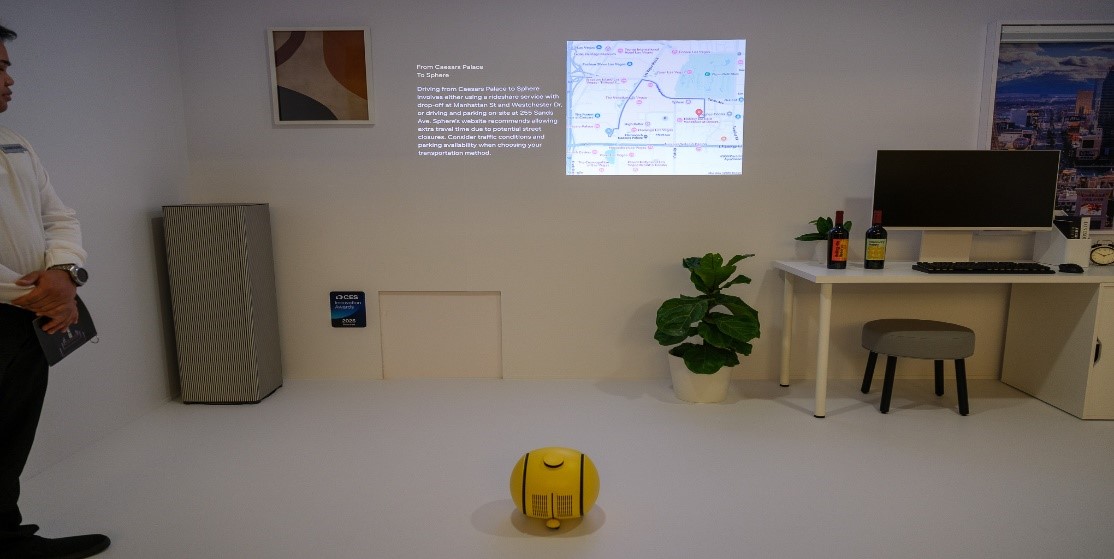
Meet Ballie — Samsung’s Friendly Home Robot
Ballie is Samsung’s small, ball-shaped home robot designed to assist....(Episode: 01)
-
What is Google’s Gemini AI?
Gemini is Google’s powerful next-generation AI model, part of its broade.....(Episode: 02)
-

Why Samsung Chose Gemini for Ballie
Samsung's decision to integrate Gemini into Ballie boosts the robot’....(Episode: 03)
-

How This Upgrade Impacts Your Smart Home
Let’s face it: technology evolves rapidly, and smart home devices....(Episode: 04)
-

What This Means for the Future of Home Robots
This collaboration signals a big leap forward for consumer AI. Combining....(Episode: 05)