

New Hydrogen-Splitting Process Could Improve Renewable Energy Storage
Researchers have developed a powerful new catalyst that may significantly reduce the cost of producing clean hydrogen, bringing renewable energy storage a step closer to large-scale practicality.
Hydrogen is widely considered one of the most promising clean fuels because it can store renewable energy and generate no carbon emissions when used. However, producing hydrogen efficiently has remained difficult because today’s best electrolyzers typically depend on rare and expensive platinum-group metals. Now, a research team led by Gang Wu, professor of energy, environmental and chemical engineering at Washington University in St. Louis, has created a new catalyst designed to overcome that challenge.
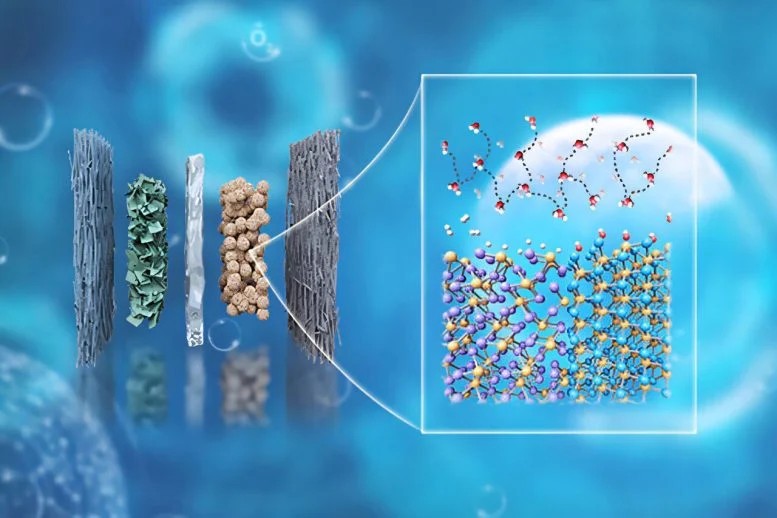
Figure 1. Hydrogen-Splitting Process.
The researchers developed a heterostructure catalyst for an anion-exchange membrane water electrolyzer (AEMWE), a technology that uses renewable electricity to split water into hydrogen and oxygen. By combining two phosphide materials, the team produced a catalyst capable of generating hydrogen efficiently without relying on costly platinum-based components. Figure 1 shows hydrogen-splitting process.
A Lower-Cost Route to Renewable Hydrogen
Wu’s team has focused on finding affordable alternatives to platinum-group-metal catalysts, which are currently among the biggest barriers to widespread hydrogen production. The idea is to use renewable electricity from solar, wind, or hydropower sources to split water molecules, converting renewable energy into hydrogen fuel that can be stored and used later., “Going from water to hydrogen is a very desirable way we are able to store energy for different applications,” Wu explained. “Hydrogen itself can be used as an energy carrier and is useful for different chemical industries and manufacturing.”
Two Materials Working Together
To create the new catalyst, researchers combined rhenium phosphide (Re2P) and molybdenum phosphide (MoP) into a composite structure where each material performs a specific role. Rhenium helps improve hydrogen adsorption and release, while molybdenum speeds up the water-splitting reaction that supplies protons within the alkaline electrolyte.
When paired with a nickel-iron anode, the new cathode outperformed leading non-platinum cathodes and even exceeded the performance of some platinum-group-metal benchmarks. The catalyst also demonstrated exceptional durability, operating at industrial current densities of 1 and 2 amperes per square centimeter for more than 1,000 hours. According to the researchers, this makes it one of the most durable platinum-free cathodes yet developed for anion-exchange membrane water electrolyzers.
Toward Industrial-Scale Hydrogen Production
Wu said the team’s findings highlight the importance of engineering the hydrogen-bond network at the catalyst-electrolyte interface to improve both efficiency and durability [1]. “Our catalyst showed the lowest resistance across the studied potential range, suggesting extremely fast hydrogen adsorption kinetics,” Wu said. “These performance and durability results make it one of the most promising membrane electrode assemblies for practical AEM water electrolyzers.”
Although the experiments were performed at laboratory scale, the researchers now plan to investigate whether the technology can be scaled up for industrial hydrogen production, potentially opening a cheaper path toward clean energy storage and hydrogen-powered industries.
References:
- https://scitechdaily.com/researchers-discover-efficient-new-way-to-split-hydrogen-from-water-for-energy/
Cite this article:
Keerthana S (2026), New Hydrogen-Splitting Process Could Improve Renewable Energy Storage, AnaTechMaz, pp.1256