

Hidden Mantle Flow Linked to Bizarre Rift Movements
Deep beneath Africa, a massive flow of hot mantle rock is gradually reshaping the continent in ways scientists are only beginning to understand. New research explains why parts of East Africa are deforming in unexpected directions, pointing to a powerful force rising from deep within the Earth.
Using advanced computer simulations, scientists have confirmed that the African Superplume—a massive upwelling of hot mantle material beneath southwest Africa—is playing a key role in how the East African Rift System is evolving and breaking apart.
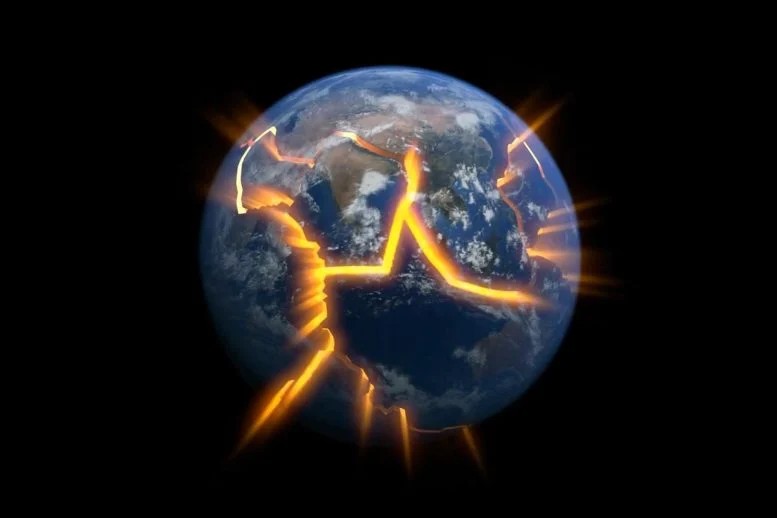
Figure 1. Bizarre Rift Movements.
Continental rifting is the slow process by which a landmass splits, eventually forming a new ocean basin over millions of years. It begins when the lithosphere, Earth’s rigid outer shell, stretches and thins. As this happens, the upper crust fractures, creating earthquakes and visible cracks, while deeper layers flow more gradually. Figure 1 shows bizarre rift movements.
How Earth’s Outer Layer Responds
Geophysicist D. Sarah Stamps compares this behavior to a familiar material. Just like Silly Putty, Earth’s lithosphere can either crack or stretch depending on how quickly force is applied. Sudden stress causes it to break, while slow, steady pulling allows it to deform smoothly.
Traditionally, scientists believed that most deformation in rift zones occurs perpendicular to the rift, pulling the crust apart sideways. While this holds true in much of East Africa, precise GPS measurements have revealed a puzzling twist—some regions are also shifting parallel to the rift.
A Deep-Rooted Explanation
To solve this mystery, researchers developed detailed 3D models of Earth’s interior. These simulations show that the unusual, rift-parallel movement is driven by a northward flow of mantle material linked to the African Superplume.
This discovery helps settle a long-standing debate. Earlier theories suggested that shallow forces, such as lithospheric buoyancy caused by variations in rock density, were the main drivers of rifting [1]. While these forces explain the expected sideways stretching, they fail to account for the newly observed parallel motion. The latest findings identify deep mantle flow as the missing piece.
The study also sheds light on seismic anisotropy—a phenomenon where seismic waves travel faster in certain directions due to the alignment of underground rocks. In East Africa, this alignment matches the direction of the superplume’s flow, reinforcing its influence.
Deep Forces, Surface Impact
Published in Geophysical Research Letters, the research highlights how processes occurring hundreds to thousands of kilometers below Earth’s surface can directly shape the continents above.
A separate 2025 study adds another layer to the story by examining microplates—small blocks of crust within the rift. One such block, the Victoria microplate, is slowly rotating counterclockwise, with most deformation concentrated along its edges while its interior remains relatively stable.
A Complex Breakup
This rotation helps explain why deformation in East Africa isn’t perfectly aligned with the rift. Instead, movement occurs at slight angles, reflecting a complex interplay of deep mantle flow, surface forces, and shifting crustal blocks.
Together, these findings reveal that the breakup of Africa is far from simple. It is a dynamic process shaped by powerful forces both at the surface and deep within the Earth—offering new insight into how continents evolve over geological time.
References:
- https://scitechdaily.com/researchers-uncover-source-of-strange-deformation-in-earths-largest-continental-rift/
Cite this article:
Keerthana S (2026), Hidden Mantle Flow Linked to Bizarre Rift Movements, AnaTechMaz, pp.1251